Mathematics
Probability tree homework: what remains in the bag?
Update the contents after each draw, distinguish one route from several, and check an original two-draw problem.
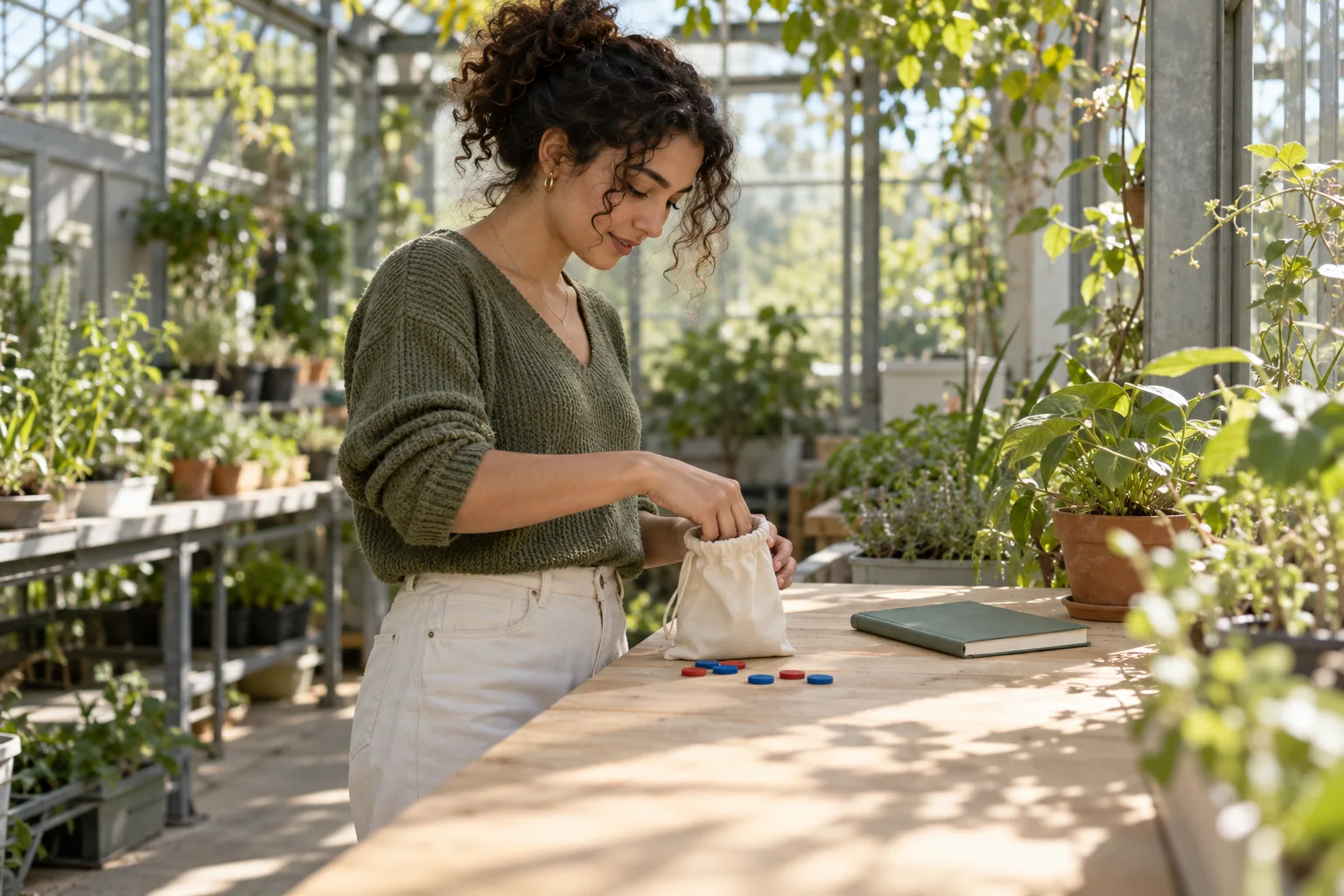
Probability tree homework often goes wrong before any multiplication begins. A student draws two branches neatly, then copies the same fractions into the second stage even though the first object has been removed. The calculation can look tidy while representing a different experiment. The useful question is not just “Which formula do I need?” It is “What is still available at this point in this particular route?”
This guide solves an original classroom-style task and shows where a Lirno hint, explanation or check can help you investigate an error. You can also complete every calculation with pencil and paper. We assume objects are equally likely to be selected, draws are random, and the first object is not returned. The photographs illustrate studying; they are not diagrams of the quantities in the problem. Follow your teacher’s notation and rules about assistance.
1. Read the probability tree homework as an experiment
Our original task uses an opaque bag containing five red counters and three blue counters. Draw two counters in sequence without replacement. Find the probability of two red counters, exactly one red counter, and at least one red counter. Before drawing anything, identify the starting total: eight. Name red R and blue B, and keep the order of selection visible even when the question eventually ignores it.
“Without replacement” means the first counter stays outside the bag before the second selection. Eight objects become seven. Which colour loses an object depends on the first draw. Assume mixing and selection make each remaining counter equally likely; colour counts alone would not justify these fractions if someone deliberately chose a visible counter. The model is a stated assumption, not a claim about every real bag experiment.
Circle exactly, at least and the number of draws. Exactly one red means RB or BR. At least one red also includes RR. A single word changes the event you must calculate. Write those acceptable routes before asking an app for an answer. That small commitment gives you something concrete to compare with an explanation later and prevents a correct calculation for the wrong question.
2. Capture the full task and verify what was recognised
If you use Lirno, photograph the complete exercise with its quantities, instruction and any diagram. Crop away names, grades or unrelated personal details. Keep the words “without replacement” in view. A picture of only the question’s final line leaves out the information that determines the second-stage denominators. For a printed tree, include branch labels and the full second stage rather than a close crop of one fraction.
Review the recognised task before requesting help. Check five red, three blue, two draws and no replacement against the original page. A scan can confuse a numeral or miss a word. If a condition is unclear, correct it or provide a clearer image before reasoning from the result. The Lirno homework scanner describes the capture workflow; a clean image still does not guarantee accurate interpretation.
Make a first attempt yourself: write 5/8 and 3/8 beside the first branches. Then ask for a hint about updating the bag after a red draw, rather than an entire submission-ready solution. A useful prompt is “After the first red counter is removed, what counts should I check?” Compare any response with the physical situation. Keep your own reasoning on the page so you can see exactly where an external suggestion changes it.
3. Build a different second stage after each first draw
After R, four red and three blue counters remain. The second branches are therefore 4/7 for R and 3/7 for B. After B, five red and two blue remain, so the second branches are 5/7 and 2/7. Do not reduce the red numerator after a blue draw: the total shrinks, but no red counter has left the bag on that route.
Each pair of outgoing branches must sum to one: 5/8 + 3/8, 4/7 + 3/7, and 5/7 + 2/7. Check one node at a time. Adding every branch across the whole drawing is not a meaningful probability check, because those labels describe different conditional situations. Write “after red” or “after blue” above the relevant split if the branching picture feels abstract.
The OpenStax section on tree diagrams compares draws with and without replacement. Use that comparison to inspect the experiment, then work with this guide’s original counts. If your task says the object is returned and the bag is mixed again, the second-stage fractions stay 5/8 and 3/8 instead. Changing that instruction changes the model, not just one arithmetic step.

4. Multiply along a route, then add distinct routes
For RR, multiply 5/8 by 4/7. This gives 20/56, or 5/14. For RB, multiply 5/8 by 3/7 to get 15/56. For BR, multiply 3/8 by 5/7, again 15/56. For BB, multiply 3/8 by 2/7 to get 6/56, or 3/28. Keep the common denominator temporarily; it makes the total easier to inspect.
Multiplication follows the sequence of a single route. The later branch already means “given the earlier result,” so you are not assuming the draws are independent. Adding the first red fraction to the second red fraction would combine probabilities referring to different stages. It would not calculate the chance of two red counters. The diagram tells you which conditional fraction belongs to which route.
Exactly one red is RB or BR. Those routes cannot both happen in one two-counter trial, so add 15/56 + 15/56 = 30/56 = 15/28. The word “or” needs care in probability generally: addition without adjustment works here because the complete routes are mutually exclusive. If you count overlapping descriptions of the same outcome, simple addition can count that outcome twice. List the routes to make the distinction visible.
5. Separate exactly one from at least one
At least one red includes RR, RB and BR. Their total is 20/56 + 15/56 + 15/56 = 50/56 = 25/28. An efficient second method uses the opposite event: no red means BB. Subtract its probability from one: 1 − 3/28 = 25/28. Agreement between two methods is useful evidence, though both methods still depend on reading the original condition correctly.
Check all four complete routes: 20/56 + 15/56 + 15/56 + 6/56 = 56/56. The probabilities are non-negative and exhaust the possible ordered colour pairs. A total of one can catch a missing route or arithmetic slip. It cannot prove every individual label is right: incorrectly repeated fractions for a different, replacement experiment can also sum to one.
Finish with an event sentence, not a bare fraction: “The probability of exactly one red counter in two draws without replacement is 15/28.” Keep exact fractions until the assignment requests decimals or percentages. If you convert, round only at the end and mark an approximation. A probability of 25/28 does not guarantee a red counter in a particular trial or prescribe a pattern across a short run of experiments.

6. Use a check to locate an error, not erase your attempt
Suppose your attempt gives RR = 25/64. Ask what experiment 5/8 × 5/8 describes. It uses the original red fraction twice, as if the first counter had been returned. A useful explanation should identify that assumption rather than merely announce 5/14. Cross out the incorrect second fraction, replace it with 4/7 and write why only four red counters remain. Preserve the correction as evidence of the idea you changed.
In Lirno Tutor, choose a hint, explanation or check appropriate to the point where you are stuck. Include your attempted branches and state whether you want a conceptual explanation or an arithmetic check. If the response gives a different answer, compare its starting counts, replacement condition and acceptable routes before accepting it. AI can misread a scan or reason incorrectly, even when its explanation sounds confident.
Lirno is free to download or start; some AI usage levels or advanced features may require Premium. This article is published by Lirno and describes a study workflow, not a tested ranking or a promise of unlimited free help. School rules still apply. Neither the app nor this guide guarantees correctness, grades, mastery or permission to use AI in an assessed assignment.
7. Change the numbers and explain what stays the same
Try a fresh bag with four green counters and two yellow counters. Draw twice without replacement. Before calculating, predict the new denominators: six, then five. After green, the remaining counts are three green and two yellow. After yellow, they are four green and one yellow. Cover the worked example and reconstruct those branches from the bag contents rather than copying a layout mechanically.
For exactly one green, the routes are GY and YG. Their probabilities are 4/6 × 2/5 = 8/30 and 2/6 × 4/5 = 8/30. The sum is 16/30 = 8/15. For at least one green, subtract YY: 1 − (2/6 × 1/5) = 14/15. Explain why the answer is larger than exactly one: the event now also admits GG. If you cannot explain that inclusion, revisit the wording before practising faster arithmetic.
Finally change only the instruction to with replacement. The denominators become six and six, and exactly one green becomes 4/6 × 2/6 + 2/6 × 4/6 = 4/9. State which assumption changed and why the previous answer no longer applies. Being able to adapt one condition is a better check of understanding than recognising the same solved example with different colours.