
Probability and exam practice
Probability tree diagram without replacement: count again
Build a two-draw tree, update the remaining counters, and distinguish one ordered path from all the paths that answer the question.
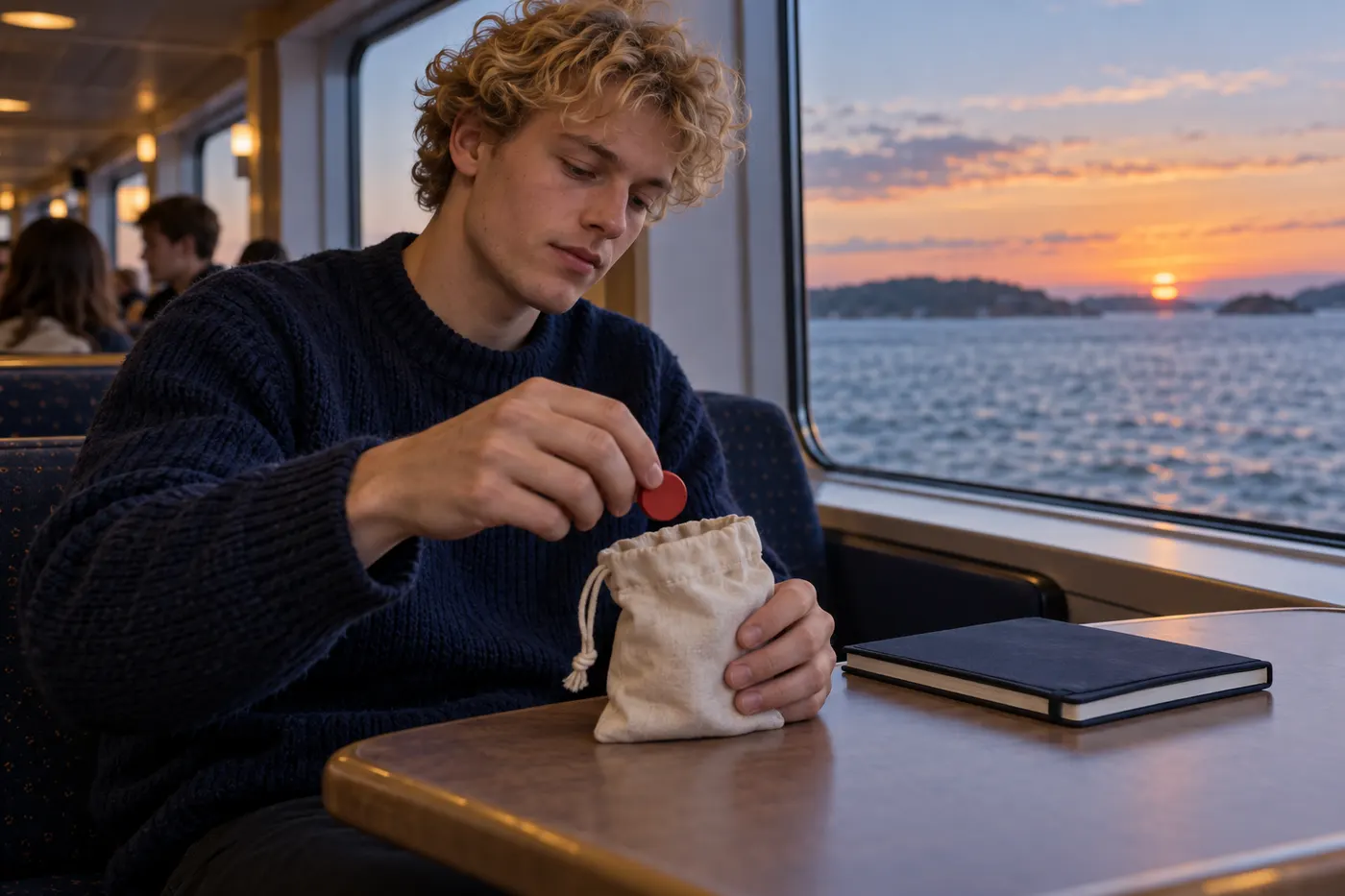
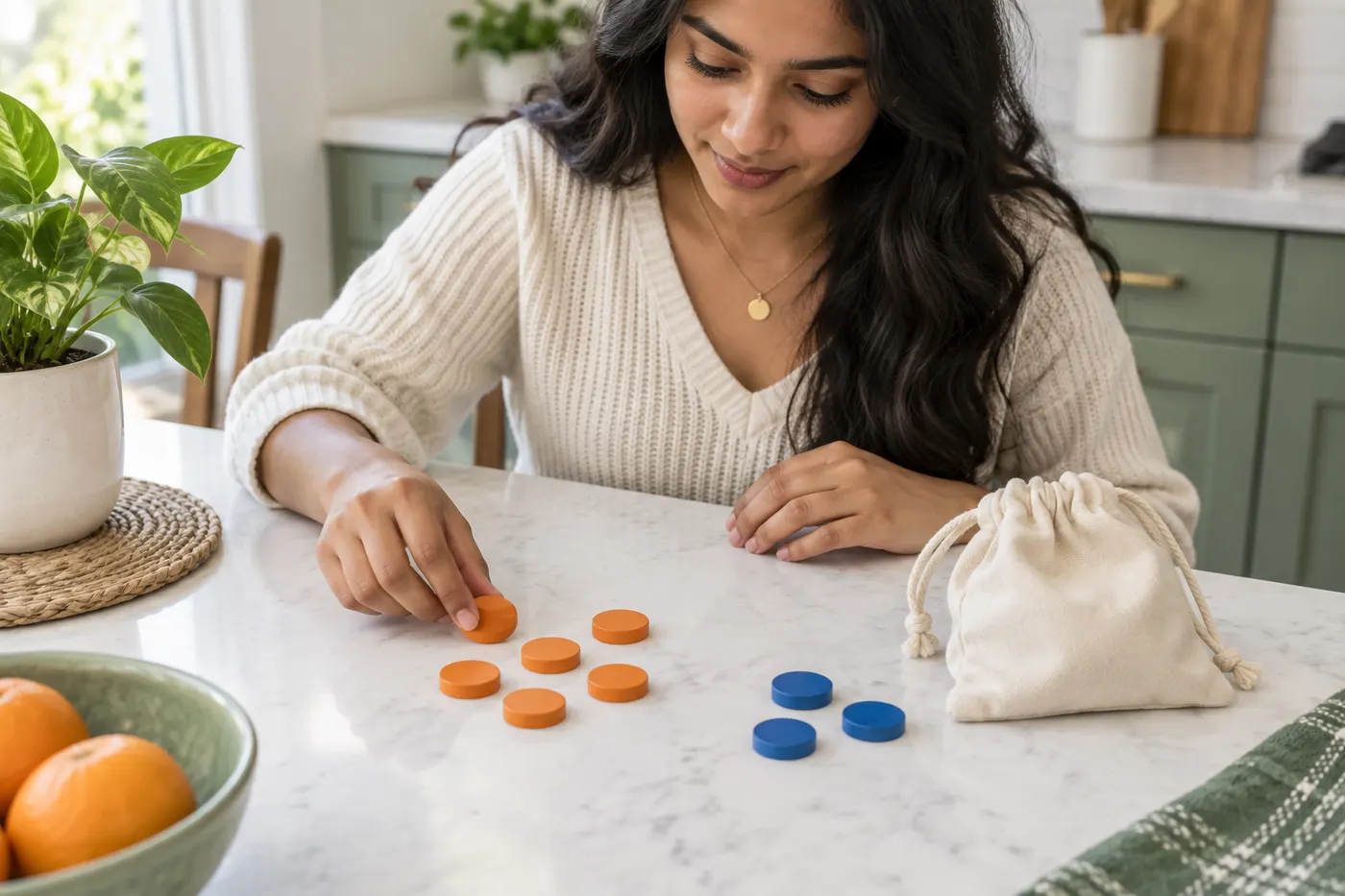
A bag contains five orange counters and three blue counters. You draw two, one after the other, and leave the first counter outside the bag. What is the probability of getting exactly one orange? The arithmetic is short, but the second draw is not the same experiment as the first. A probability tree diagram without replacement helps you keep track of what remains after each possible first result, rather than repeating the original fractions automatically.
This guide solves that invented problem from the wording through the final check. It assumes identical counters apart from colour, a well-mixed opaque bag, and equal chances of selecting each remaining counter. You can follow the method on paper without an app. The important skill is choosing the right paths: orange then blue is only one way to get exactly one orange. A diagram is useful when every branch describes a real possibility and every fraction has a reason.
1. Read the experiment before drawing the tree
Write down the starting inventory, number of draws, and replacement rule. Here the inventory is five orange and three blue, the total is eight, and there are two draws without replacement. Circle the phrase exactly one orange. Do not quietly replace it with first orange or at least one orange: those questions select different outcomes. Keep the original wording beside your work so you can return to it after the calculation.
Check what random selection means in the problem. If counters differ in size or you choose by looking into the bag, the simple count-based model may not apply. For a classroom exercise, use the assumptions stated or reasonably intended; for a real experiment, explain the selection process. For a probability tree diagram without replacement, the OpenStax section on tree diagrams provides a reference for representing successive draws. Our counter counts and worked questions below are original practice examples, not a copied answer key.
2. Build a probability tree diagram without replacement
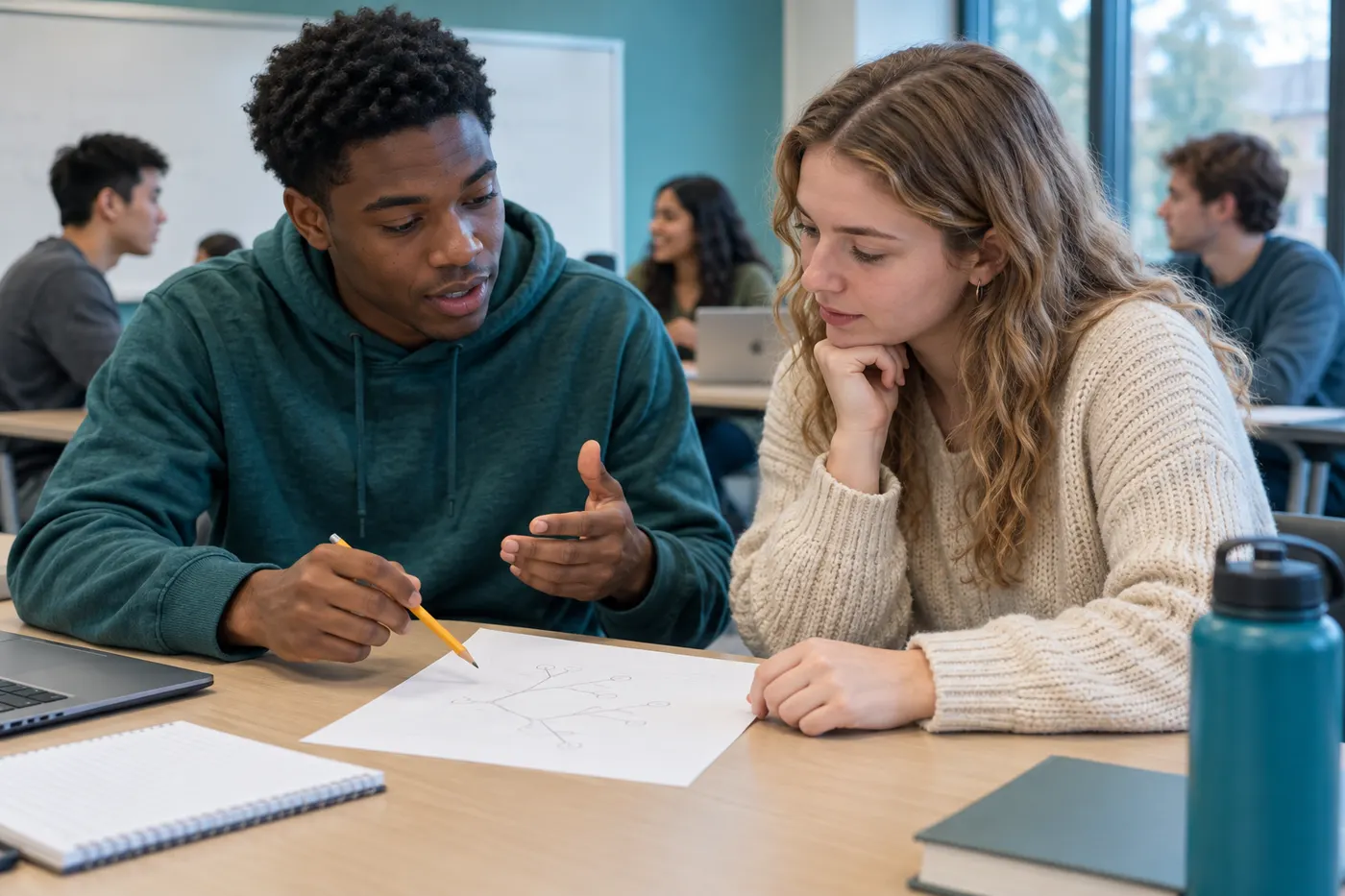
Put a starting point on the left, then draw two branches to the right. Label the first O for orange and the second B for blue. Their probabilities are 5/8 and 3/8. These two outcomes cover every possible first colour, so their probabilities add to one. The branch label describes a colour category, not one individual counter; five different counters belong to the O branch.
Leave enough room for a second pair of branches after each first result. A two-draw tree has four complete colour sequences: OO, OB, BO, and BB. Put each sequence at its endpoint. You are recording order even if the final question does not care about order. That detail prevents you from overlooking BO when asked for one orange and one blue. Use both letters and colours if you draw coloured lines, so the structure remains readable without colour alone.
3. Update both numerator and denominator without replacement
After an orange first draw, that counter stays outside the bag. Four orange and three blue counters remain, seven in total. The next O branch therefore has probability 4/7, and the next B branch has probability 3/7. After a blue first draw, five orange and two blue remain. On that side of the tree, the second probabilities are 5/7 and 2/7. Write the remaining inventory beside each node before writing its fractions.
Notice that every second denominator is seven, but the numerators depend on the first colour. Reducing only the denominator is not enough; the selected colour also loses one counter. Reducing both colours would remove two counters when only one was drawn. At each second-stage node, check that the two outgoing fractions add to one: 4/7 + 3/7 and 5/7 + 2/7 both do. These are local checks; do not add all six branch labels together.
4. Multiply along one complete path
For OO, the first orange has probability 5/8 and the second orange, given the first, has probability 4/7. Multiply to get 20/56, or 5/14. For OB, use 5/8 × 3/7 = 15/56. For BO, use 3/8 × 5/7 = 15/56. For BB, use 3/8 × 2/7 = 6/56, or 3/28. Keep these four endpoint probabilities next to their full sequence labels.
The multiplication uses the second probability appropriate to that path. It does not assume the draws are independent. A common error is using 5/8 × 5/8 for OO just because both draws ask for orange. Without replacement, the first orange changes the available stock. You can read the product as 'first orange, then another orange from what remains.' Explain that sentence aloud before simplifying the fraction; it reveals a wrong second branch more easily than a calculator display does.

5. Add the paths that match exactly one orange
Exactly one orange means OB or BO. The sequences are different complete outcomes: a single two-draw trial cannot be both of them. Add their probabilities, 15/56 + 15/56 = 30/56 = 15/28. That is about 0.536, or 53.6%. State the event with the result: 'The probability of exactly one orange in two draws without replacement is 15/28.' An unlabeled fraction makes it difficult to tell which question you answered.
Do not multiply the two path probabilities together. They are alternatives, not two stages within one trial. Also avoid doubling a path by habit. OB and BO happen to have equal probabilities in this example, but different multi-stage problems can have unequal alternatives. Identify every matching endpoint, calculate each full path, then add. If the instruction explicitly asks for orange first and blue second, only OB matches, so the answer is 15/56 rather than 15/28.
6. Use the complement for at least one
At least one orange includes OO, OB, and BO. You can add all three: (20 + 15 + 15)/56 = 50/56 = 25/28. A shorter route is to notice that the only excluded sequence is BB. Its probability is 6/56, so the answer is 1 − 6/56 = 25/28, about 89.3%. Write the excluded event, no orange, next to the subtraction so the complement is visible.
Exactly one and at least one are not interchangeable. Exactly one excludes OO; at least one includes it. Read these phrases carefully in a test, particularly when a question changes only one word from the previous part. A complement works when your event and its opposite cover every outcome without overlap. If the question asks for a particular order or gives an extra condition, first identify the outcomes under that condition rather than subtracting an unrelated probability from one.
7. Check the entire tree with a second method
All four endpoint probabilities should add to one: 20/56 + 15/56 + 15/56 + 6/56 = 56/56. A missing endpoint, a repeated path, or a wrong remaining count can break this check. Passing it is useful but not proof that every label is correct; errors can occasionally cancel. Return to each node and confirm its inventory as well. Finally check that the probability you report is between zero and one and answers the named event.
There is another check using individual counters. Temporarily imagine numbering the eight counters. There are 8 × 7 = 56 ordered pairs without replacement. For exactly one orange, 5 × 3 pairs have orange then blue and 3 × 5 have blue then orange. That gives 30 favourable ordered pairs out of 56. This agrees with the tree. Do not use these counts if the counters are not equally likely. For other ways of checking a mathematical model, browse the study guides and compare how assumptions are made explicit.
8. Change the rule and test what really changes
Now put the first counter back and mix before the second draw. Every second branch returns to 5/8 for orange and 3/8 for blue, because the starting stock is restored. Exactly one orange becomes 5/8 × 3/8 + 3/8 × 5/8 = 30/64 = 15/32. Compare this with 15/28 without replacement. The two answers differ because the experiment differs, not because one multiplication rule is a shortcut for the other.
If you have counters, run a few trials of each procedure and keep the procedures separate. A short trial set will not necessarily match the theoretical proportion. Record what happened without adjusting counts to make them look right. Simulation can illustrate the model, but a small observed percentage does not replace its calculation. Try a second inventory of four orange and two blue without replacement: exactly one orange is 4/6 × 2/5 + 2/6 × 4/5 = 16/30 = 8/15.
9. Practise the decisions, then inspect any digital help
Cover the worked fractions and redraw the original tree. Say what remains after O and after B, then solve two questions with different wording. If you get stuck, identify whether the difficulty is inventory, path selection, or arithmetic. Keep one corrected example with its reason. Lirno's study-practice workflow can help turn a checked idea into another practice task, but the paper method is sufficient to solve this problem independently.
If you ask AI to review a scan, verify the counts, replacement instruction, and event wording first. AI can misread or reason incorrectly; compare its explanation with your inventory and the full tree. School rules still apply, and Lirno does not guarantee correctness, grades, mastery, or permission to submit assisted work. Finish with a brief justification that includes the changing stock and the selected paths. Your answer should explain why the calculation fits the experiment, not merely display the final number.