Chemistry homework
Dilution homework: calculate the stock volume
Find the stock volume for dilution homework, distinguish final volume from solvent added, and check your answer using a solute balance.

A chemistry worksheet asks you to make 250 mL of a solution at 0.120 mol/L from a stock solution at 0.800 mol/L. One student writes 37.5 mL. Another writes 212.5 mL. Both numbers can arise from the same arithmetic, but only one answers the question “What volume of stock solution should you take?” Dilution homework gets much easier when you identify the liquid and the stage described by each number before you touch the calculator.
This guide uses an invented classroom problem, so the concentrations do not describe a particular chemical or an experiment to try at home. You will solve for the volume of stock solution, test the result in two independent ways, and practise spotting a different question that uses the same numbers. If your school permits it, Lirno can help you check a transcription or ask for a focused hint after you have made an attempt.
Dilution homework starts with the labels
Draw two columns. In the left column, write “stock portion” and enter 0.800 mol/L as the concentration. Leave its volume blank. In the right column, write “finished solution” and enter 0.120 mol/L and 250 mL. Circle the blank space in the left column. The task asks how much stock to take, so the unknown is on that side. The full bottle of stock might hold a litre or much more. You only need the volume of the portion you transfer.
Read the instruction carefully enough to say whether 250 mL describes the final mixture or the water added. “Dilute to 250 mL” sets the final volume. “Add 250 mL of water” gives the volume of solvent added. They are different instructions. A worksheet can ask you to estimate the final volume from two added volumes under a stated assumption, but the dilution equation itself does not say that mixing volumes are always exactly additive.
You can mark a third line below the columns for the solvent if that helps. Write “adds no solute” on that line for this problem. The solvent makes the total volume larger without adding the dissolved substance you are tracking. If the added liquid contains the same solute, or if a reaction uses up the solute, this particular balance is incomplete. That is why the wording around the numbers matters as much as the numbers themselves.
Write the quantity that stays the same
Concentration in mol/L tells you how many moles of solute there are per litre of solution. To find the amount of solute, multiply the concentration by a volume expressed in litres. The two products are equal here because every mole in the stock portion ends up in the finished solution, assuming that none is lost and the solvent supplies none. That gives C₁V₁ = C₂V₂, where the subscripts refer to the portion before dilution and the final solution.
Read the equation aloud as “moles transferred equal moles in the final mixture.” If a formula sheet uses different letters, keep the relationship and relabel the symbols. The OpenStax discussion of molarity and dilution explains how this balance relates to concentration and volume. Notice that the concentration decreases as the volume increases for the same amount of solute. Neither concentration nor total solution volume is conserved in this step.
A useful prediction is that the stock portion must be less than the finished 250 mL. The final solution is less concentrated, so spreading the same solute out requires more total volume. If your rearrangement gives a stock volume larger than 250 mL, stop before rounding. You may have inverted the concentration ratio. A prediction catches that error even before you check the numbers.
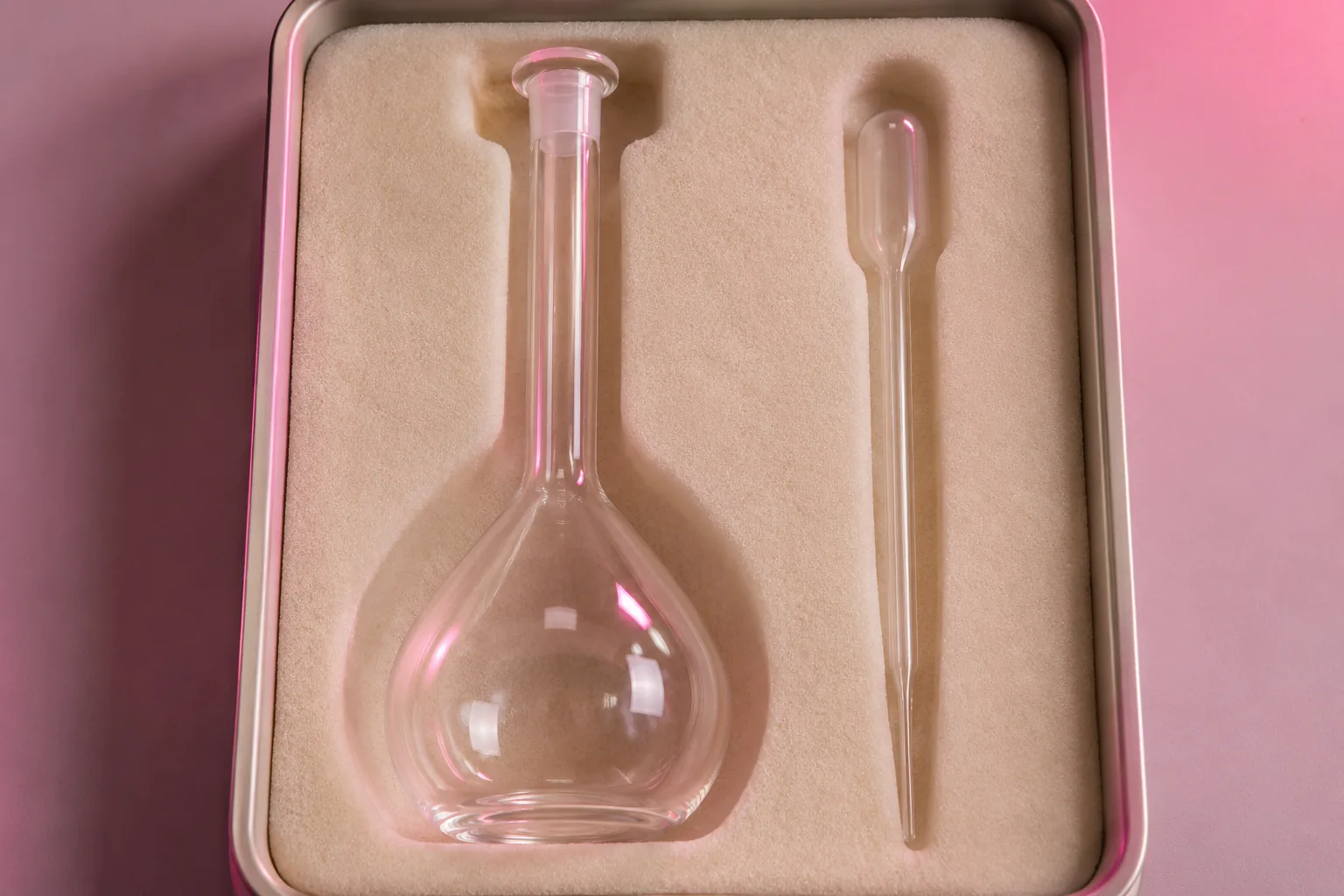
Calculate the stock volume two ways
Start with the final side. The finished volume is 0.250 L. Multiply 0.120 mol/L by 0.250 L to find 0.0300 mol of solute. The litre units cancel, leaving moles. Now ask how much stock contains 0.0300 mol. Divide by 0.800 mol/L to get 0.0375 L, or 37.5 mL. In a written answer, attach the label “stock solution” to 37.5 mL. A bare number with units still leaves room for confusion about what you measured.
You can also calculate directly with the ratio 0.120 ÷ 0.800 = 0.150. The two concentrations use the same units, so the ratio has no unit. Multiply 250 mL by 0.150 to get 37.5 mL. This method can keep volumes in millilitres because the same volume unit appears on both sides. If you calculate the amount in moles in a separate step, however, use litres with mol/L. Treating 250 mL as 250 L would produce an amount a thousand times too large.
For a reverse check, divide the original concentration by the desired concentration. That ratio is about 6.67. The final volume should therefore be about 6.67 times the stock volume. A quick division of 250 by 37.5 gives that same factor. Keep extra digits while doing the calculation. If the assignment has a specific convention for significant figures, apply it to the final result. A unit conversion does not create new measurement precision.
Explain why the other number is tempting
Subtracting 37.5 from 250 gives 212.5. Under a simplified additive volume assumption, that is the estimated volume of solvent added. It is not the volume of stock you transfer. The difference matters even when the estimate is numerically accurate. In a supervised preparation with a volumetric flask, the instruction is commonly to add solvent until the mixture reaches the final mark. The mark defines the final volume. It is not a separate measurement of how much water went in.
Another common mistake is to write 0.800 × 250 on the stock side because both are prominent numbers in the prompt. But 250 mL belongs to the finished solution. The easiest correction is to look for the first place in your work where a value joined the wrong label. If that happens repeatedly, record it as a distinct error in your exam error log and make a new question whose final volume and solvent amount are deliberately different.
A third trap is to assume that a unit such as g/L can be substituted for mol/L without a conversion. If both concentrations refer to mass per litre of the same solute, you can use a balance of mass instead of moles. If the units differ, convert first using the appropriate molar mass and check what substance the problem is tracking. A percentage may refer to mass, volume, or mass per volume, so read the definition before trying to adapt the equation.

Ask Lirno to check one decision at a time
If using the app is allowed, capture the complete worksheet question, including the units and any sentence below the table. Keep names and other personal information outside the frame. Check the captured prompt against the original. In this example, confirm that the decimal point in 0.120 survived, that mL was not read as L, and that the wording says “to 250 mL” rather than “with 250 mL of water.” If the image missed a line or the interpretation is wrong, correct the prompt before working from it.
Start on paper. Put the three known values in the two columns and write the solute balance. If you are stuck, ask for a hint about which quantity belongs in the blank. If the symbols are the problem, ask for an explanation using the names of the two solutions. After solving, give your own equation and ask for a check of the first questionable step. A useful request is “Check whether I used the correct volume with each concentration. Let me fix the arithmetic myself.” Compare the reply with the worksheet rather than accepting a plausible-looking number.
AI can misread a scan or reason incorrectly. In particular, an answer can reproduce the right equation and still confuse solvent with final solution. Lirno does not guarantee a correct result, a grade, mastery, or permission to use its output. Follow your school’s rules for homework and lab work. Keep the work here on paper unless your teacher provides the materials and supervises the practical exercise.

Turn the solution into a new question
Try changing the stock concentration to 0.600 mol/L and the final concentration to 0.150 mol/L. Set the final volume to 200 mL. Cover the earlier calculation and decide whether the stock portion should be roughly a quarter or roughly four times the final volume. Because the final solution has one quarter of the stock concentration, you need one quarter of the final volume as stock. That gives 50 mL. Reverse the calculation by multiplying 0.600 mol/L by 0.050 L and comparing it with 0.150 mol/L times 0.200 L. Both give 0.030 mol.
Now keep the 50 mL of stock but change the final volume to 300 mL. This time the unknown is the final concentration. The amount of solute is still 0.030 mol, and dividing by 0.300 L gives 0.100 mol/L. Explain in a sentence why the new concentration is lower even though you did not change the stock portion. If you cannot explain it without looking at the formula, go back to the two columns and label the quantity that stayed fixed.
You can save these variations as practice questions from your notes. Put “stock volume,” “final concentration,” and “solvent added” on three cards. Pick one card before writing a new prompt, and change the wording so that it really asks for that quantity. The practice is complete when you can identify what the question asks, predict the direction of the answer, and use the other method to check your result.