Geometry homework
Prism volume homework: base first, then height
Separate the triangle’s height from the prism’s height, keep the units consistent and check your own calculation with targeted help.

Prism volume homework becomes easier when you stop treating every labelled length as a number to multiply. First identify a base face, calculate its area and find the perpendicular distance to the matching base. For a triangular prism, this usually involves two different heights: one inside the triangle’s area calculation and another between the prism’s ends. Naming those roles is more reliable than guessing from the drawing’s orientation.
This guide solves original right-prism tasks on paper and explains a concrete Lirno capture, hint, attempt and check workflow where school rules allow it. The practice questions are free to use here and do not require an app or account. We cover rectangular and triangular bases with sufficient measurements supplied. Curved solids, pyramids, composite shapes and advanced methods for finding missing base dimensions need additional reasoning; do not apply a prism formula to every three-dimensional picture.
1. Prism volume homework: identify the solid and quantity
A right prism has two congruent parallel polygonal bases, with lateral edges perpendicular to their planes. The cross-section parallel to those bases stays the same throughout the solid. Its volume is the base area multiplied by the perpendicular distance between the bases. Write V = B × H, where B is an area and H is that distance. The capital letters are our labels; use your teacher’s notation if it differs, while keeping the meanings clear.
The base is not necessarily the face drawn at the bottom of the page. In a triangular prism lying on its side, the two matching triangular ends are the bases. Rotating the sketch does not change them or the volume. Also distinguish a right prism from a right-angled triangle: “right” describes the prism’s lateral edges here, while its triangular base does not have to contain a right angle. Read the actual markings instead of assuming one.
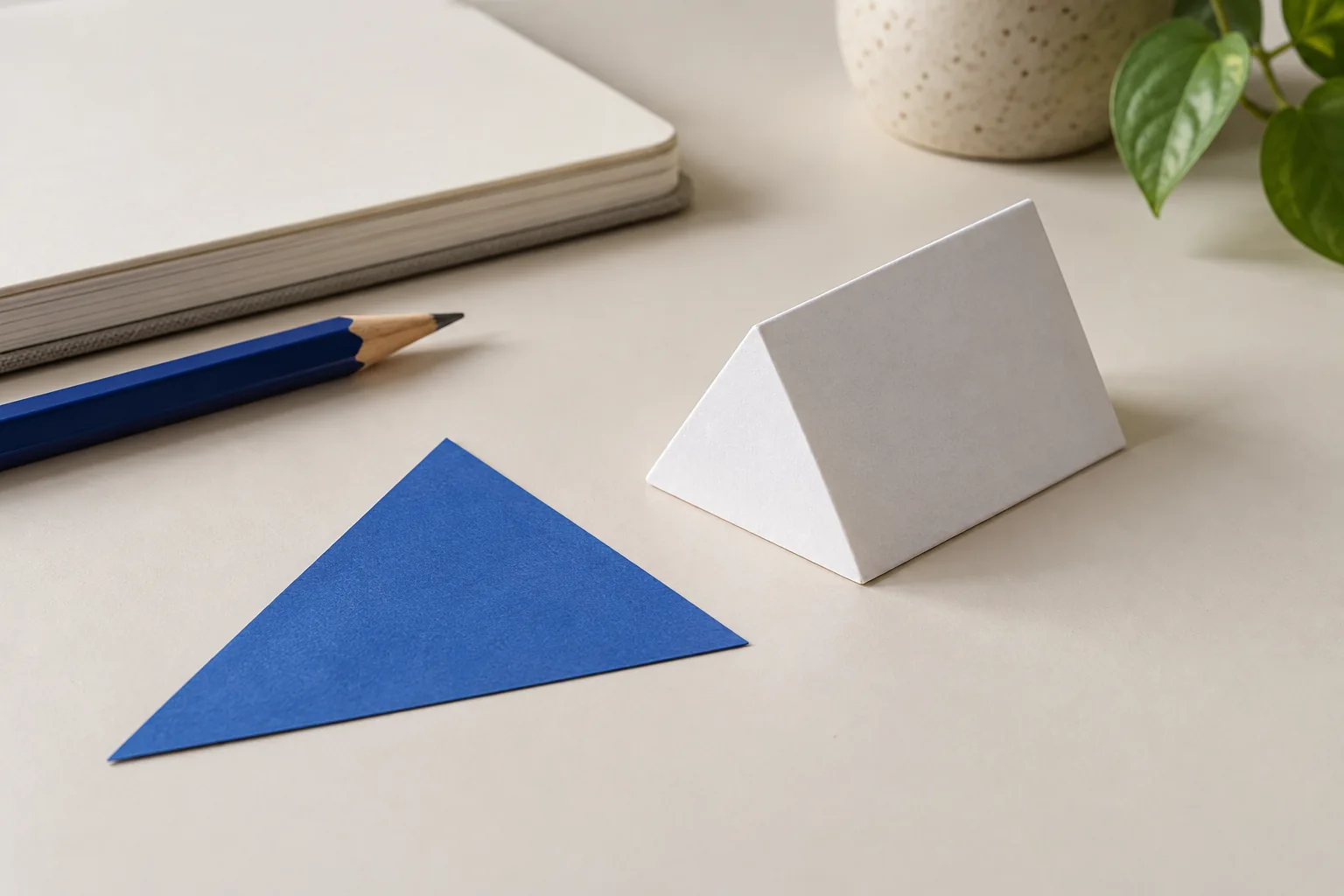
Check the requested quantity before calculating. Volume measures three-dimensional space and uses cubic units; surface area measures the total area of the boundary and uses square units. Adding the faces of a net answers a different question from finding volume. The OpenStax treatment of rectangular solids connects base area, height and cubic measure. Our examples are original, and the photos are illustrative study scenes rather than labelled geometry diagrams.
2. Capture every dimension and verify what was recognised
If you use Lirno, capture the complete question, diagram, units and right-angle markings. Include any separate instruction saying which dimension is unknown. A crop that removes “mm” can turn a unit-conversion problem into a different calculation. Lay the sheet flat, avoid a shadow across a small superscript and keep the whole solid in view. If you include your own working, make sure it does not cover a dimension or the task instruction.
Compare the captured information with the paper before requesting help. Check 6 versus 9, decimal points, cm² versus cm³ and which line a measurement belongs to. A label near a sloping edge is not automatically a perpendicular height. Lirno’s homework scanning workflow describes capture and review. Successful recognition supplies input for reasoning, not proof that the selected formula or the interpretation of the diagram is correct.
Choose a narrow hint before asking for a full explanation. A useful request asks which two faces are the matching bases, or which given segment measures their perpendicular separation. Write your own proposed B and H first. If the explanation refers to an edge that the diagram does not mark, return to the original. Do not let an attractive three-dimensional sketch or an AI-generated interpretation supply a missing fact that the assignment never gave.

3. Calculate one triangular base, not two
Consider an original right triangular prism whose triangular base has a side of 8 cm and a perpendicular triangle height of 6 cm. The distance between the triangular bases is 9 cm. First calculate only the triangle’s area: B = (8 × 6) ÷ 2 = 24 cm². The factor one-half belongs to the triangle. Do not yet multiply by the prism’s 9 cm, because you are finding a two-dimensional area at this stage.
The 6 cm must be perpendicular to the chosen 8 cm side, not merely another edge carrying a convenient label. A triangle’s sloping side is not generally its altitude. The OpenStax triangle properties reference reviews this area relationship. If an altitude is not supplied, a separate valid method may be needed. Do not estimate a missing perpendicular height by measuring a worksheet picture unless the task explicitly asks for a scale measurement.
Use the area of one base even though the prism has two matching ends. Doubling 24 cm² because there are two triangles confuses volume with a surface-area calculation. Likewise, a rectangle measuring 8 cm by 6 cm would have area 48 cm²; omitting the division by two doubles this example’s volume later. Keep the area line visible and labelled. A correct final number alone cannot show that you have identified the dimensions correctly.
4. Multiply by the prism’s perpendicular height
Now use the 9 cm separation between the triangular bases: V = 24 cm² × 9 cm = 216 cm³. Notice the change in dimension: an area multiplied by a length produces volume. You may combine the steps as V = (8 × 6 ÷ 2) × 9, but the two-stage layout makes the roles easier to inspect. For this example, the triangle height is 6 cm and the prism height is 9 cm.
Multiplication is commutative, so merely swapping the positions of 6 and 9 in the combined product gives the same number. That numerical coincidence does not make their geometric roles interchangeable: the base area is still 24 cm², not 36 cm². If the question later asks for a base dimension or surface area, the distinction matters. Label the quantities by what they measure rather than relying on the calculator to expose every misunderstanding.
For a rectangular prism with a chosen rectangular base of 4 cm by 3 cm and perpendicular height 7 cm, B = 12 cm² and V = 84 cm³. There is no division by two because that base is a rectangle. There is also no division by three: that factor belongs to pyramid or cone formulas, not this prism task. A pointed-looking perspective drawing is not a reason to switch formulas without identifying the solid.
5. Convert lengths before multiplying and check cubic units
Return to the triangular example, now written with mixed units: base side 8 cm, triangle height 60 mm and prism height 0.09 m. Convert to centimetres first: 60 mm = 6 cm and 0.09 m = 9 cm. The same calculation gives B = 24 cm² and V = 216 cm³. Multiplying 8, 60 and 0.09 directly would mix three incompatible numerical scales and hide the error behind a plausible decimal.
Area and volume conversions use squared and cubed length factors. Because 1 cm = 10 mm, 1 cm³ = 1,000 mm³. Therefore 216 cm³ = 216,000 mm³. Because 1 dm = 10 cm, 1 dm³ = 1,000 cm³, so the same volume is 0.216 dm³. Do not divide by ten merely because the names of the units are one step apart. Imagine how many small cubes fit along all three directions.
If the base area is already supplied, convert it as an area rather than treating it as a length. For B = 3 m² and H = 250 cm, change 250 cm to 2.5 m, then V = 7.5 m³. Do not convert the number 3 with an ordinary length factor. Write units on each line so they reveal whether you are combining an area and a length or accidentally multiplying unrelated labels.

6. Rearrange the formula when a dimension is missing
Suppose a prism has volume 126 cm³ and base area 18 cm². From V = B × H, divide both sides by B to obtain H = V ÷ B. Here H = 126 ÷ 18 = 7 cm. The units confirm the result: cubic centimetres divided by square centimetres give centimetres. Substitute back to check that 18 cm² × 7 cm reproduces the stated 126 cm³.
Do not divide by the perimeter when the formula requires area. Perimeter measures a boundary length, so dividing volume by it would leave square units, not a prism height. If you know V and H instead, B = V ÷ H gives an area. Finding an individual triangle side from that area requires the triangle’s relevant height as well. A single volume does not determine all the dimensions of a prism; many different shapes can share it.
Sometimes the base calculation genuinely requires another topic. If the assignment supplies enough right-triangle information to find a missing altitude, the Pythagoras homework guide can help with that separate step. Check that the triangle is right-angled and identify its hypotenuse before using that theorem. Do not introduce extra algebra or a guessed diagonal when the given base area already lets you use V = B × H directly.
7. Use a hint or check to find the first wrong decision
For the main example, imagine your attempt gives 432 cm³ from 8 × 6 × 9. The arithmetic is correct, but the expression used a rectangular area instead of the triangular one. Ask Lirno to check the base-area step, then explain why one-half is needed in your own words. A targeted hint is more informative than replacing your working with a complete answer that you cannot reconstruct. Correct the first decision before redoing later multiplication.
You can also ask for an explanation of the difference between the triangle’s altitude and the prism’s height, or a check of a specific conversion. Keep your annotated sketch beside the response. AI can misread labels or reason incorrectly; a fluent explanation does not establish that an unmarked angle is right. School rules still apply, and Lirno guarantees neither correctness, grades, mastery nor permission to use AI. Follow any requirement to disclose help and ask your teacher when evidence remains unclear.
The paper method and exercises here are free and usable without Lirno. If you choose the app, Lirno is free to download or start; some AI usage levels or advanced features may require Premium. That does not mean unlimited free checking. Decide which uncertainty you want to investigate before using assistance, make your own attempt and verify the suggested change. The goal is to understand the geometric roles, not to collect repeated confirmations of the final number.
8. Practise a new prism and justify the result
Try three original paper questions before reading the checks. A rectangular prism has base dimensions 5 cm and 4 cm, with prism height 7 cm. A triangular prism has a base side of 10 cm, corresponding perpendicular triangle height 3 cm and prism height 8 cm. A third prism has base area 15 cm² and volume 90 cm³; find its height. For each, write which quantity is an area before multiplying or dividing.
The rectangular base has area 20 cm², giving 140 cm³. The triangular base has area 15 cm², giving 120 cm³. The third height is 90 cm³ ÷ 15 cm² = 6 cm. Verify these by substituting back and checking the units. As a further reasoning check, doubling only a prism’s height while keeping its base area fixed doubles its volume; doubling all three linear dimensions of a similar solid multiplies volume by eight.
If permitted, use Lirno’s study and practice workflow to turn an identified mistake into a similar question with changed values. Keep the original task separate so you do not accidentally submit a practice answer. Then cover the examples, identify the bases of a fresh sketch and explain both height roles aloud. Your written answer should include the formula, the base-area calculation, consistent units and the requested quantity, rather than a bare number copied from a screen.