Study skills
Oral Presentation Notes: Speak from Prompts
Build oral presentation notes with clear prompts, accurate evidence and timed rehearsal. Keep your explanation natural without losing the thread.
Oral presentation notes should help you recover the next idea while you talk. If your page contains every sentence, it is easy to look down once and keep reading. If it contains only three unexplained words, you may lose the connection between your claim and its evidence. Useful notes sit between those extremes: enough structure to guide you, enough space to explain in your own words.
This guide builds a speaking outline for a short classroom presentation. You will decide what the audience needs, turn material into prompts, and rehearse with the notes you will actually use. The example is invented, so its numbers are practice material rather than research findings. Follow your teacher's instructions about scripts, sources, permitted aids and accessibility adjustments before choosing a format.
Give your talk one clear destination
Start with the assignment, not the slide design. Write down the required question, the audience, the time allowance and what will be assessed. A report of an investigation needs different evidence from a persuasive proposal. If questions count inside the time limit, reserve space for them. Check whether notes, a full script or a particular presentation format are required; a cue-card approach is not a reason to ignore those requirements.
Complete a sentence that describes what a listener should understand at the end. For an invented class investigation, that sentence might be: our school should compare refill-station use at different times before deciding where another station belongs. This is more precise than announcing a topic such as water bottles. It gives you a test for material: does this detail help explain the question, the evidence or the limit of the conclusion?
Make a small route with an opening, two or three main points and an ending. Do not assume that every talk needs exactly three points. A short demonstration may need one process with several steps. If the assignment asks you to evaluate, include a reasoned limitation rather than using the whole talk to describe. Your destination is an answer to the task, not simply a list of facts you found interesting.
Build oral presentation notes around speaking jobs
A prompt should tell you what to do next. Instead of copying a paragraph onto a card, identify its job: define the measure, describe the observation, explain a comparison or qualify a claim. Then add a few words that bring that job back to mind. If you cannot explain a prompt without reading the original paragraph, you have probably compressed it before you understood it.
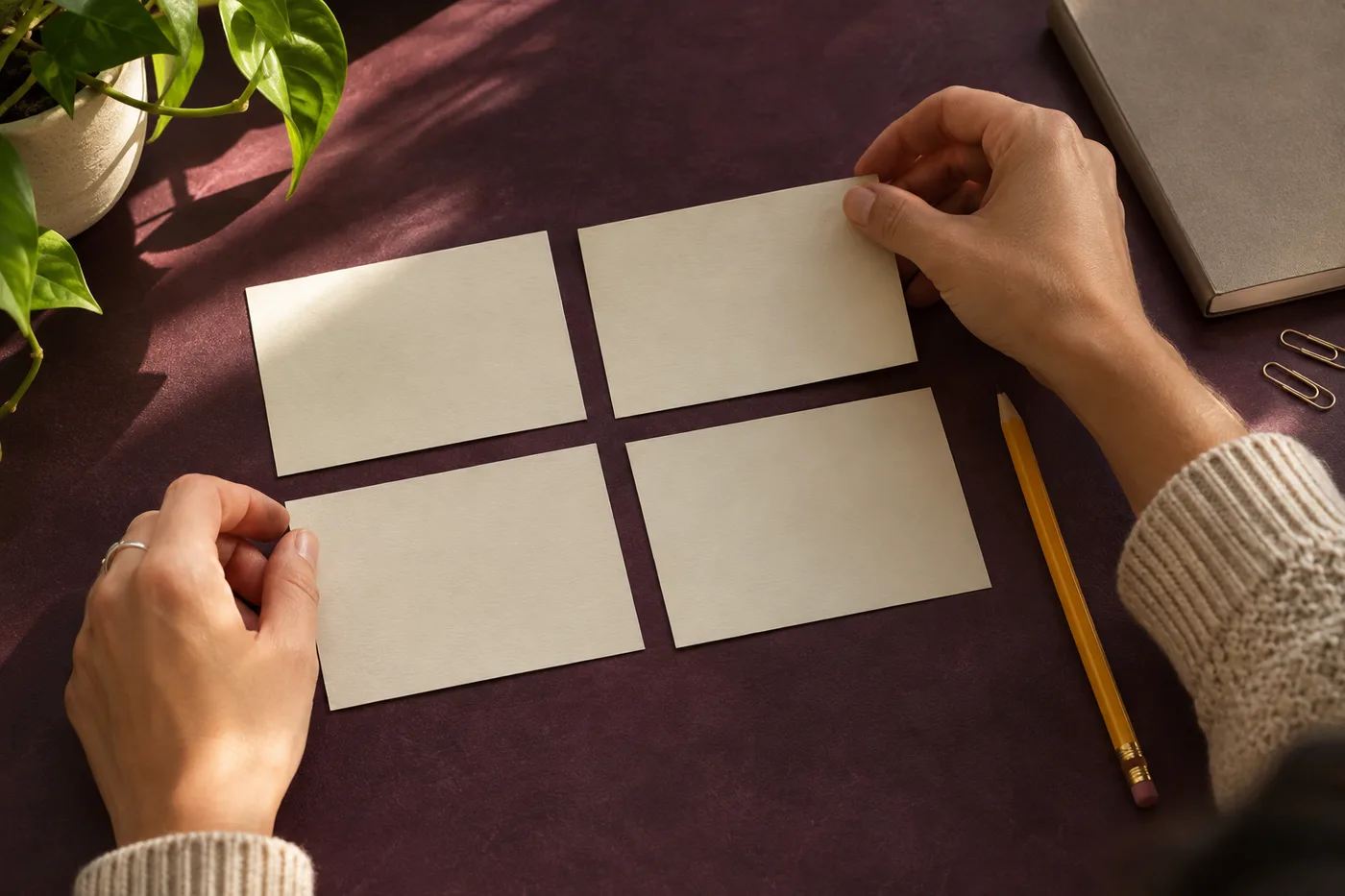
Use one card or a clearly separated area for each main point. Give it a short heading, a small set of cues and the evidence you must state accurately. Numbers, names, technical spellings and source details may need fuller wording than familiar explanations. You can write an exact quotation in full when necessary, marking it unmistakably as quoted material. Brief notes do not mean replacing accurate information with vague memory.
For example, a practice card might contain: lunchtime observation; east station twelve refills; west station eight; one day only; no claim about all weeks. The numbers here are invented. The card preserves the observation and its boundary while leaving you to explain the connection. A second card could ask what additional observations would make the decision better. This creates a progression instead of repeating the same finding in different words.
Keep evidence attached to the claim
Imagine you collected the fictional lunchtime counts above. You could describe a difference of four recorded refills during that observation. You could not conclude that every student prefers the east station or that a new station will certainly reduce waste. Your notes should preserve the difference between what was observed, what you infer and what remains unknown. Add a reminder such as one location period, no preference survey, beside the relevant point.
Keep enough source information to identify real borrowed material. When a task requires oral attribution, put a cue at the moment you use the claim, not only on a final reference slide. Keep the full reference in your working document. The guide to citing sources in an essay explains how to maintain an evidence trail; apply your presentation's required citation style rather than assuming that spoken and written attribution are identical.
Separate your own observation from an outside explanation. You may use a definition from a textbook to explain a measure, but that definition does not validate the numbers you collected. In a group, agree who introduces each source and who states each limitation. Otherwise two speakers can accidentally turn a cautious statement into a stronger claim simply by leaving out the qualification during a handover.
Make the page easy to navigate
Choose a format you can handle where you will stand. Small cards may work when you need to move, while a large-print sheet on a lectern may suit another speaker better. Number the cards or pages and keep their sequence obvious. Put the next transition near the bottom. A note such as now explain the limitation is more useful during a pause than a decorative heading that repeats the slide title.
Leave visible gaps between ideas. If you repeatedly miss a particular number, make that item easier to find instead of enlarging every line. Test the actual print or screen size from your normal speaking distance. Colour can support navigation, but the outline should still make sense without it. If you use a digital aid, check power, permissions and what happens when the device locks; do not put essential prompts only in an unreliable connection.
Full sentences can be useful for a difficult opening, a precise definition or an agreed accommodation. Treat them as deliberate support, not as a failure. If reading a script is required, focus on pauses and emphasis rather than secretly replacing it with cards. If your notes contain personal interview details or identifiable student information, remove what the audience does not need and follow consent and school rules before sharing the file.

Rehearse an explanation, then measure it
Practise aloud with the same notes, order and visual aids you intend to use. Silent reading does not show where you need a breath, where a transition is missing or how long a diagram explanation takes. In the first run, notice the places where you stop because a cue is unclear. Change that cue into something more meaningful. Do not fill every pause by adding another paragraph to the page.
Time a complete run from the actual opening through the final sentence. There is no speaking speed that fits every learner, language and subject. Use your own rehearsal to decide what fits. If a five-minute task takes seven minutes, remove a less necessary example or shorten a repeated explanation. Speaking faster can make important evidence harder to follow. Keep enough room for a pause, a slide change and any required questions.
For broader preparation, UNSW's presentation guidance covers structure and delivery. Use that general guidance alongside your assignment criteria. A practical feedback request is narrower than asking whether the talk was good: ask a listener to state your main conclusion and identify which evidence supported it. Their answer helps you locate a missing connection, not predict a grade.

Prepare a recovery route and a real ending
You do not need a memorised sentence for every possible interruption. Mark a few places where you can restart: the question, the next main point and the conclusion. If you lose your place, pause, look at the heading and explain that point in a simpler sentence. Returning to the audience with a clear idea is more useful than searching for the exact wording of an abandoned sentence.
Write a closing cue that answers the original question and keeps its limitation. In the invented example, that could be: observed difference at lunchtime; repeat observations before choosing a location. Do not introduce a new statistic in the last seconds. If the audience asks something your evidence cannot answer, distinguish a reasonable next investigation from an established result. Saying that you have not measured something is more accurate than improvising a confident explanation.
For a group presentation, practise the handovers as part of the complete talk. Each speaker should know the preceding point and the next person's first idea. Keep shared terms and units consistent. If one speaker is absent, ask the teacher how to handle the assessment rather than claiming someone else's work as your own. Decide which material can be shortened without removing the central evidence or changing the meaning of a conclusion.
Check the notes against what you actually understand
After rehearsal, cover one card and explain its point without looking at the full script. Then uncover it and check the evidence and qualification. You are testing understanding, not proving that memory must replace all support. When a point breaks down, return to the source or your calculation. A prettier card will not repair an explanation you do not yet understand. Keep the improved cue and try that section aloud again.
If your research pile is too large, the guide to summarising without copying can help you distinguish a central idea from its original wording. Do not upload classmates' personal information to an AI tool to shorten the notes. AI can invent sources, misread material or give faulty reasoning; school rules still apply. Lirno cannot guarantee correctness, marks, mastery or permission to use assistance.
Finish by checking the question, timing, evidence, source cues and readable order together. Keep only prompts you have actually rehearsed, plus any required exact wording. Your final notes should make the next useful action obvious: introduce the question, explain a point, show its support, state a limit or close the answer. That is a stronger preparation target than achieving a particular number of cards or memorising every sentence of a polished draft.