
Reading and writing
How to summarize a text without copying it
Learn how to summarize a text by finding its central claim, selecting essential support, writing from memory, and checking every sentence against the source.
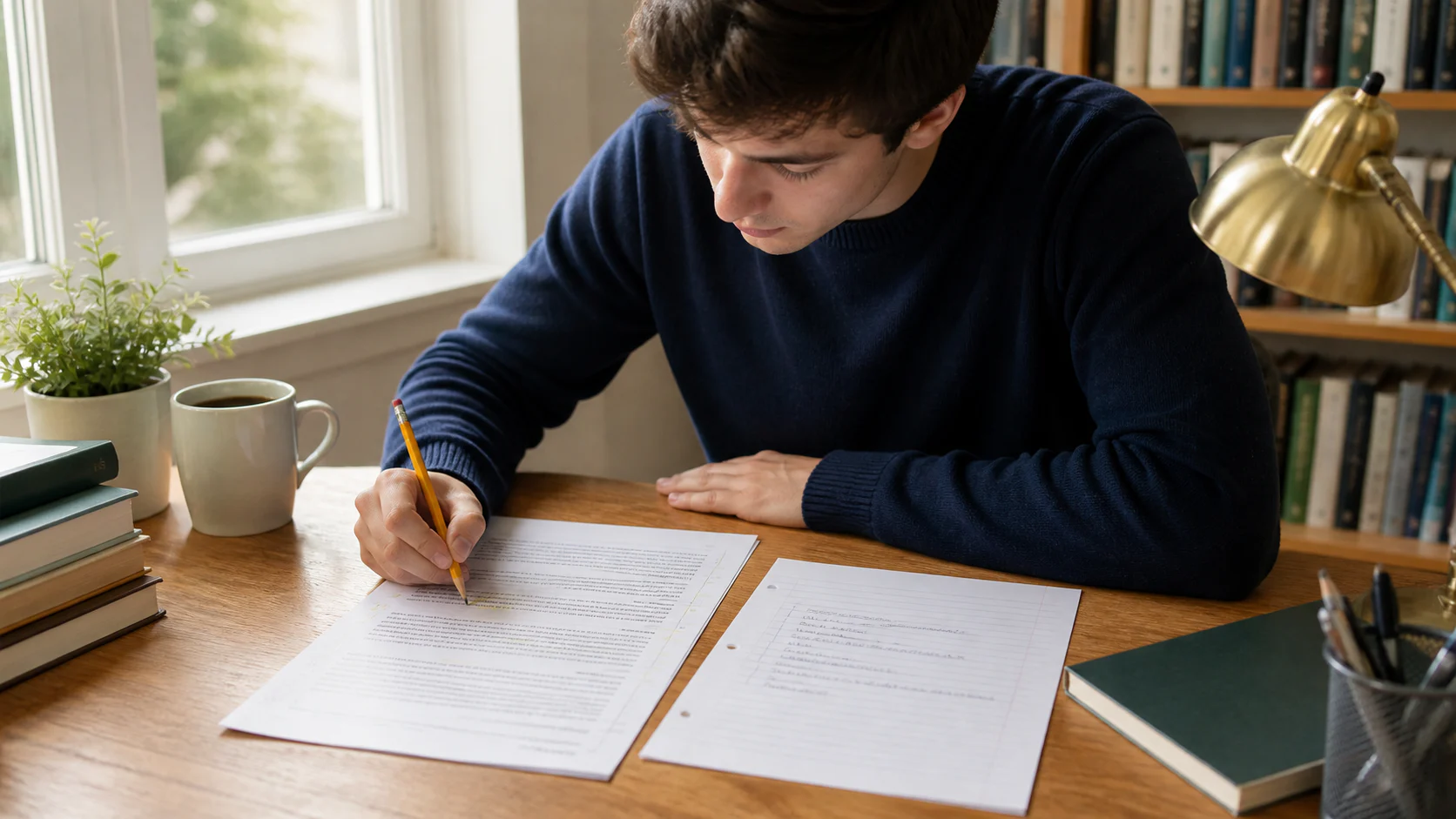
To summarize a text, state its central idea and the essential points that develop it, using fewer words and a clear logical order. Read first for meaning, make a short map of the argument or events, put the source aside, and draft in your own words. Then compare the draft with the original to correct distortion, missing links, copied phrases, and added opinions.
A summary is not a list of highlighted sentences and not a review. Its exact form depends on the assignment: a narrative summary follows the important change, while an informational or argumentative summary follows the claim and support. The workflow below works by hand. Lirno can also help you scan a passage, identify its structure, check a draft, and turn the finished summary into recall practice, but you still verify the source and follow your teacher's rules.
1. Read the assignment before the source
Underline the task verb, required length, audience, source type, and any required focus. ‘Summarize the author’s explanation of climate migration’ is narrower than ‘summarize the article.’ A word limit changes how much evidence can remain, while a class rubric may require an opening reference to title and author.
Do not assume every teacher uses ‘summary’ in exactly the same way. Some want only source content; others expect a brief response after it. Keep those parts separate so your opinion does not enter a section that should remain neutral.
- What exactly must be summarized?
- How long should it be?
- Must title, author, or date appear?
- Is evaluation required separately?
2. Find the central idea before highlighting details
Read the whole passage once without trying to shorten every line. Ask what the text is mainly trying to explain, show, or argue. Then write that idea as one provisional sentence. If the sentence names only the broad topic, it is not specific enough: ‘the text is about pollution’ says less than ‘the text explains how urban runoff carries pollutants into rivers.’
Check the title, introduction, conclusion, repeated terms, and turning points, but do not treat any single sentence as automatically decisive. The central idea must account for the text as a whole.
Main-idea test: could this sentence explain why the author included most of the important paragraphs?

3. Give every paragraph a short job label
Beside each paragraph, write a few words describing its job: defines the problem, gives a cause, presents evidence, contrasts a view, shows a consequence, or proposes a response. For narrative text, note the situation, turning point, important decision, and outcome.
Now group repeated jobs and remove details that only illustrate a point already captured. Examples, quotations, decorative description, and minor statistics are usually omitted unless the assignment or central argument depends on them.
- Keep claims, causes, consequences, and essential stages
- Keep a detail only when the logic breaks without it
- Combine repeated support
- Leave out commentary and interesting side facts
4. Build a summary map before writing sentences
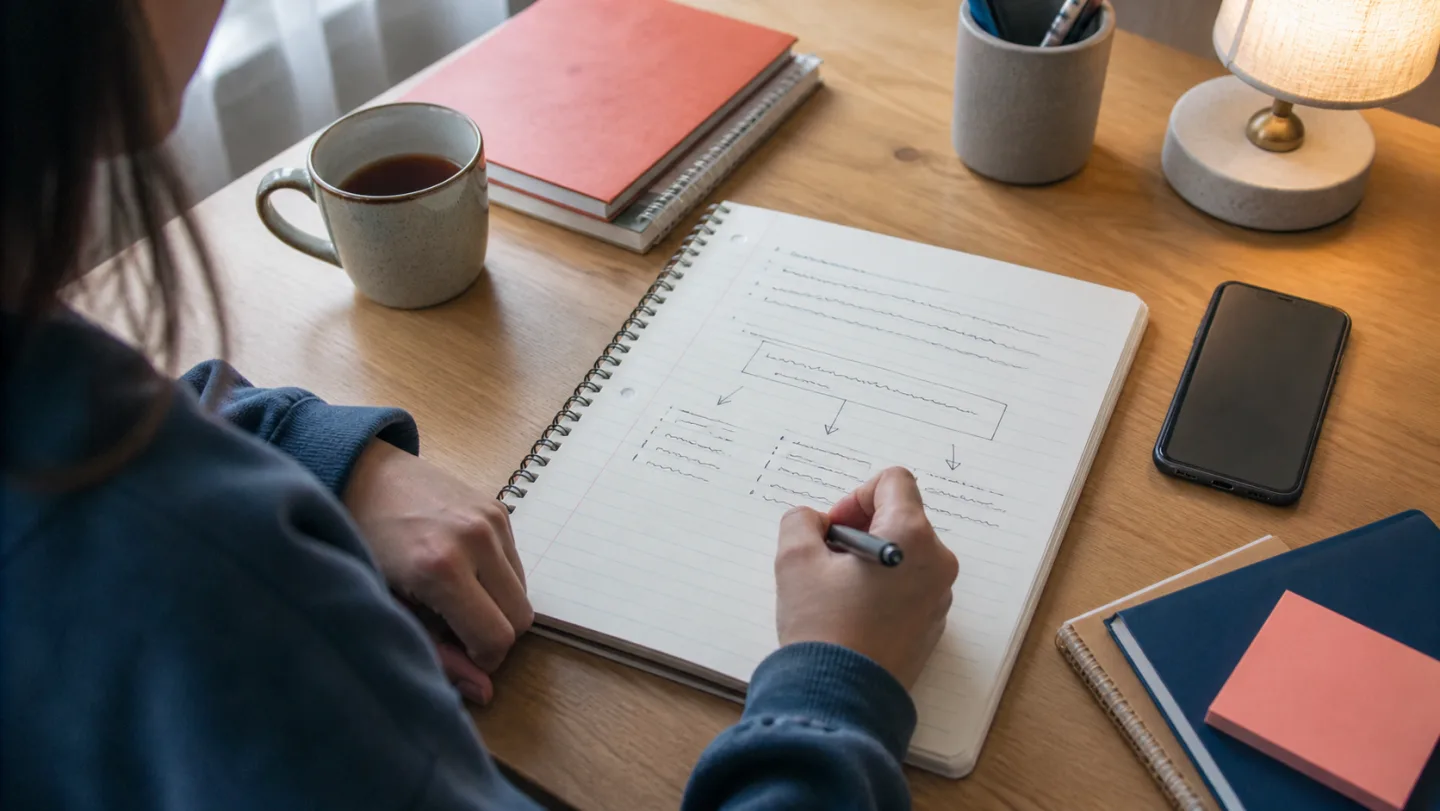
Arrange the retained ideas in the source’s logical order. A simple map might be central claim → reason one → reason two → consequence. A narrative might be starting situation → conflict → decisive event → result. This map prevents the summary from becoming a pile of disconnected facts.
Give each map item a proportion. One minor paragraph should not occupy half the summary merely because it contained an easy example. The space in your draft should reflect the importance of the ideas, not the number of words in the original.
If you cannot connect two points with because, however, therefore, or then, check whether a logical step is missing.
5. Draft in your own words with the source closed
Put the original aside and write from the map. This reduces patchwriting, where a writer swaps a few words but keeps the source’s sentence structure. Preserve technical terms that cannot sensibly change, but rebuild the surrounding explanation in language you genuinely understand.
Use concise connections so the reader can follow the relationship among ideas. Do not add examples, judgments, or background knowledge that the author did not supply. If you need a direct quotation, use it only when the assignment allows it and mark it correctly.
- One clear purpose per sentence
- Neutral reporting verbs when needed
- Consistent tense and point of view
- No unsupported interpretation
6. Audit accuracy, independence, and length
Reopen the source and compare each summary sentence. Ask whether it preserves the author’s meaning, emphasis, qualifications, and sequence. Watch for absolute language: changing ‘may contribute’ to ‘causes’ makes the summary shorter but false. Restore any condition that limits the claim.
Circle wording that closely matches the original and rewrite it after looking away. Then remove repetition and low-value detail until the required length is met. Do not cut the linking logic that makes the remaining ideas understandable.
- Every sentence traceable to the source
- No changed certainty or cause
- No copied sentence patterns
- All essential links still present

7. Use Lirno as a structure-and-check partner
If the source is on paper, scan the complete passage in Lirno and verify that paragraphs, headings, negatives, names, and figures were read correctly. Ask for the text’s structure or one question that helps you identify the central idea; keep any generated summary hidden while you make your own map and draft.
Paste or photograph your draft and ask Lirno to compare it with the source for one issue at a time: missing main idea, added opinion, distorted certainty, or wording too close to the original. Accept a suggestion only after finding the evidence yourself. Finally, turn the summary into a short quiz or flashcards and answer without the text, so the work supports learning rather than only submission.
Useful prompt: ‘Check whether my summary preserves the author’s main claim and qualifications. Point to the first mismatch, but do not rewrite it for me.’

Use the Lirno Tutor for a focused check · Turn notes into a trustworthy practice quiz
8. Adapt the method to the kind of text
An explanatory text usually moves from a question or concept through causes, mechanisms, and consequences. Preserve that chain. An argumentative text needs the author’s position, the main reasons, and any important qualification or counterargument. Listing facts without showing what they support will misrepresent the argument even when every fact is accurate.
A narrative summary follows change rather than every event. Name the starting situation, the central problem, the choice or event that alters it, and the outcome. For a scientific report, keep purpose, method, central result, and conclusion distinct. Do not force every source into the same school-summary template.
- Explanation: concept, causes, process, consequence
- Argument: claim, reasons, evidence, qualification
- Narrative: situation, conflict, turning point, outcome
- Report: purpose, method, result, conclusion
9. Practise with one paragraph before a long article
Take a paragraph about urban trees. It might state that trees cool streets through shade and evaporation, then give temperatures from two neighborhoods and mention lower energy use as a consequence. The topic is urban trees, but the paragraph’s job is to explain how they reduce heat and why that matters.
A useful one-sentence summary could say that urban trees lower street temperatures through shade and evaporation, which can reduce cooling demand. The neighborhood measurements support the point but may be removed when the length is tight. This small exercise teaches selection before you manage several pages.
Mini-example rule: keep the relationship the evidence proves, not every piece of evidence used to prove it.
10. Summarize a long chapter without losing the thread
Divide a long source into meaningful sections rather than equal page ranges. After each section, close it and write one sentence that captures its contribution to the whole. When all section sentences are visible, label duplicates, supporting examples, and genuine turning points. Then write one central sentence that explains how the sections relate.
Do not simply join the section summaries. That usually produces a miniature table of contents instead of one coherent text. Combine repeated ideas, subordinate evidence to claims, and adjust the space after you know the chapter’s overall purpose. Keep page references in your notes so you can verify a detail later without rereading everything.
- Split by idea or stage, not page count
- Write one contribution sentence per section
- Mark repetition and hierarchy
- Synthesize the section notes into a new whole
11. Repair the most common summary problems
If the draft is too long, the issue is often selection rather than sentence style. Return to the paragraph-job labels and remove examples, repeated evidence, and background that does not change the central idea. If the draft is too short to make sense, restore the cause, contrast, or sequence that connects the retained claims.
If the summary sounds like a review, circle evaluative words such as convincing, unfair, interesting, or weak and ask whether the source used them. If it sounds copied, reduce the source to concept notes and rewrite after a short break. If it distorts the author, compare verbs and qualifiers before changing vocabulary.
- Too long: reduce support, not the main logic
- Too short: restore essential relationships
- Too subjective: remove evaluation
- Too close: remap concepts and redraft
12. Perform a final reader test before submitting
Give the summary to someone who has not read the source, or read it aloud as if you were that person. Can the reader identify what the text says, how the important ideas connect, and where the source ends and your voice begins? Mark any pronoun without a clear reference and any transition that assumes missing information.
Finish with two separate checks. First, compare for fidelity: no essential claim omitted, no detail invented, no certainty changed. Second, edit the summary as an independent piece of writing: concise sentences, consistent terms, correct attribution, and the requested format. Save your map and source notes until the work is graded in case you need to explain a choice.
Submission test: a reader should understand the source’s core message without mistaking your summary for the original or for your opinion.