
Biology homework
Free biology homework help: Punnett squares made clear
Set up a monohybrid Punnett square correctly, separate genotype from phenotype, calculate probabilities, and catch the mistakes that spoil otherwise good genetics work.

This free biology homework help guide shows how to solve a basic Punnett square without memorizing a ratio. Begin with the parents' genotypes, separate the alleles each parent can place in a gamete, combine one allele from each parent in every box, and count the requested outcomes. Keep genotype, phenotype, probability, and predicted number of offspring separate, because most errors happen after the grid is filled.
The method is designed for the simplified single-gene, complete-dominance problems commonly used to introduce Mendelian genetics. Real inheritance can involve incomplete dominance, codominance, multiple genes, linkage, sex chromosomes, environmental effects, and chance. A Punnett square describes possible combinations under the stated model; it does not guarantee what any particular child, seed, or litter will be like. Use the assignment's symbols and assumptions rather than applying one familiar ratio automatically.
1. Translate the genetics words before drawing the grid
A gene is a unit of inherited information, while an allele is one version of that gene. In a simplified diploid problem, each parent has two alleles for the gene but contributes only one through each gamete. The pair of alleles is the genotype. The observable category described by the problem is the phenotype, which may also be influenced by environment and other genes in real organisms.
Dominant does not mean stronger, healthier, more common, or more likely to be inherited. It means that, in the model given, one copy is enough for the associated phenotype to appear. A recessive phenotype usually requires two recessive alleles. OpenStax's explanation of Mendel's characteristics and traits is useful background for segregation, dominant and recessive relationships, and the limits of these classroom models.
- Allele: a version of a gene
- Genotype: the allele combination
- Phenotype: the described observable outcome
- Gamete: carries one allele for this gene
2. Pull the parent genotypes from the question
Do not begin with an empty square. First underline each parent's phenotype and any word that fixes the genotype: homozygous dominant, heterozygous, carrier, homozygous recessive, or true-breeding. Copy the allele letters chosen by the question. Conventionally, the dominant allele uses a capital letter and the recessive allele the matching lowercase letter, but the worksheet's notation always takes priority.
Some phenotypes do not determine a unique genotype. Under complete dominance, an individual showing the dominant phenotype could be homozygous dominant or heterozygous unless more information is supplied. Do not silently choose one. Look for parentage, offspring data, or a phrase such as ‘heterozygous.’ If the genotype remains unknown, state that the problem has more than one possible cross.
Before drawing anything, you should be able to write a two-letter genotype for each parent or explain why the genotype is not uniquely known.
3. Separate each parent's alleles into possible gametes
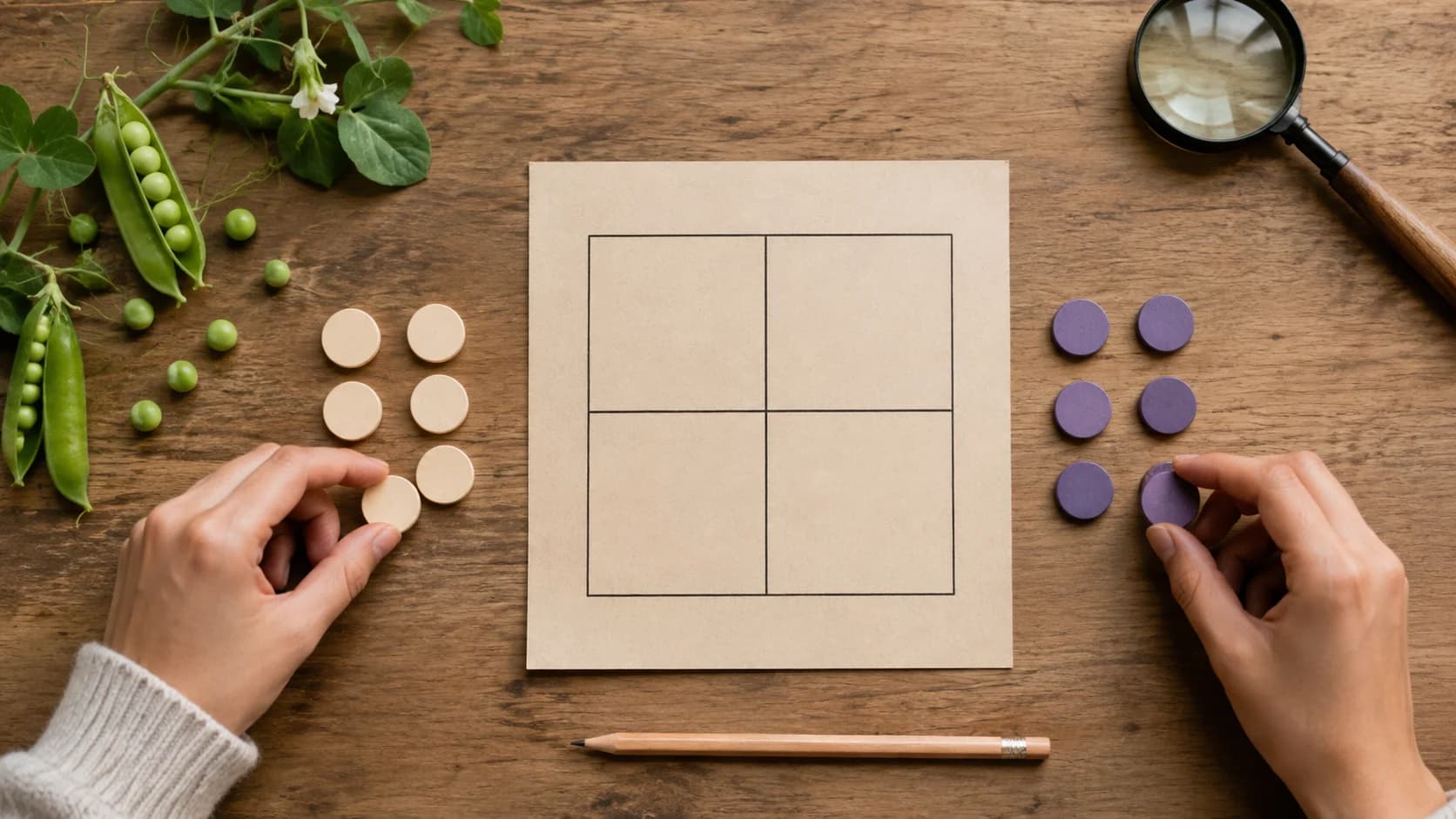
A monohybrid parent with genotype Aa can produce gametes carrying A or a. A parent with AA produces only A gametes, while aa produces only a. The two identical labels are often written twice around a two-by-two square for symmetry, but they do not represent different allele types. This separation is the biological reason for the row and column labels.
Write one parent's possible gametes across the top and the other's down the side. Which parent goes where does not change the probabilities. What matters is that the labels are gametes, not the complete two-letter parental genotypes. Putting Aa above every column and Aa beside every row creates four-letter boxes and shows that segregation was skipped.
- AA produces A gametes
- Aa produces A or a gametes
- aa produces a gametes
- Each gamete contributes one allele per gene

4. Fill every box with one row allele and one column allele
Move through the square systematically. Each box receives the allele at the top of its column and the allele at the start of its row. Write the capital allele first when a genotype contains one capital and one lowercase version, so aA becomes Aa. This ordering does not change the biology, but consistent notation makes duplicate outcomes easier to count.
For the cross Aa × Aa, the four boxes are AA, Aa, Aa, and aa. Pause before interpreting them. The boxes represent equally likely combinations only when the gametes shown are equally likely under the simplified assumptions. They are possible zygote genotypes, not four actual offspring, and the repeated Aa boxes represent the same genotype reached by two routes.
Grid audit: every box must contain exactly one allele from each parent, never two from the same side.
5. Count genotype probabilities before phenotype probabilities
Genotype answers preserve the allele combinations. In Aa × Aa, one of four boxes is AA, two are Aa, and one is aa. Report those as 1/4, 2/4, and 1/4, or 25%, 50%, and 25%. A genotype ratio can be written 1 AA : 2 Aa : 1 aa when the question asks for a ratio rather than percentages.
Phenotype counting comes afterward and depends on the inheritance rule. With complete dominance, AA and Aa share the dominant phenotype, so three boxes belong to that category and one to the recessive phenotype. In incomplete dominance or codominance, the heterozygote has a distinct phenotype, so combining those boxes would be wrong. Read the model before converting letters into traits.
- First count exact genotypes
- Then apply the stated inheritance pattern
- Reduce fractions only when useful
- Label every ratio or percentage clearly
6. Understand what the probability actually predicts
A probability of 25% does not mean every group of four offspring must contain exactly one matching individual. Each fertilization is a separate event, and small families can differ greatly from the expected ratio. The square describes the long-run distribution predicted by the model, not a schedule in which outcomes must appear once each.
If a question asks for an expected number, multiply the probability by the number of offspring. For 80 offspring with a predicted probability of 1/4, the expectation is 20. Label it expected, not guaranteed. If the question asks for the probability that the next offspring has the trait, earlier births do not use up or force an outcome under the simple independent-event model.
Probability describes uncertainty across repeated events; the four cells are not four promised children or seeds.
7. Work a second cross instead of memorizing 3:1
Consider a heterozygous parent crossed with a homozygous recessive parent: Aa × aa. The first parent supplies A or a, while the second supplies only a. The boxes become Aa, aa, Aa, and aa. The genotype probabilities are therefore 1/2 Aa and 1/2 aa. Under complete dominance, the phenotype probabilities are also one half dominant and one half recessive.
This example explains why 3:1 is not a universal Punnett-square answer. The outcome changes with the parental genotypes and inheritance pattern. An AA × aa cross gives only Aa offspring under the model, while Aa × Aa gives three genotypes. Build the cross from the prompt every time; never start by writing a remembered ratio beside an empty grid.
- Identify both parent genotypes
- List the gametes each can form
- Combine every row and column
- Count only after the grid is complete
8. Distinguish genotype, phenotype, and carrier questions
A question about the recessive genotype asks for aa. A question about the recessive phenotype also points to aa only under the stated complete-dominance model. A question about carriers usually asks for heterozygotes such as Aa: they possess the recessive allele but show the dominant phenotype. These are different categories even when the same grid supplies every answer.
Underline the noun in the final question: genotype, phenotype, carrier, probability, ratio, or expected number. Then write a sentence, not a bare percentage. For example, ‘The model predicts a 50% probability of heterozygous offspring’ is much clearer than ‘50%.’ It identifies what was counted and prevents a correct number from answering the wrong question.

9. Recognize when a two-by-two square is the wrong model
A simple monohybrid grid assumes one gene with two allele options and known parental genotypes. It may not fit traits affected by many genes or environment. Incomplete dominance, codominance, multiple alleles, sex-linked inheritance, lethal combinations, linkage, and unequal gamete survival require different interpretation or a different setup. Follow the inheritance information given in the problem.
Human traits are especially easy to oversimplify. Classroom examples sometimes treat complex traits as if one dominant allele controlled them. Use such examples only as the hypothetical model stated by the assignment, not as reliable predictions about real people. A Punnett square cannot establish a person's genotype from appearance alone, diagnose a condition, or replace genetic counseling.
- Check the number of genes and alleles
- Identify the inheritance pattern
- Confirm that parent genotypes are known
- Keep model predictions separate from real-person claims
10. Fix the five mistakes that cost the most marks
The first common error is translating the parents incorrectly. The second is writing full genotypes as gamete labels. The third is taking two alleles from one parent into a box. The fourth is counting dominant alleles instead of individuals with the dominant phenotype. The fifth is reporting a ratio without saying whether it describes genotype or phenotype.
Audit the work in reverse. Add the probabilities and confirm they total 100%. Check that every box contains one contribution from each parent. Compare the phenotype count with the inheritance rule. Finally, reread the exact question and attach a label to the result. This short routine catches mistakes that a neatly drawn square can hide.
Do not ask only ‘Is my grid right?’ Ask whether the parent genotypes, gametes, combinations, interpretation, and requested output are each right.
11. Turn free biology homework help into recall practice
After finishing one problem, cover the grid and explain why Aa creates two gamete types while aa creates one. Then solve a changed cross with new letters. Mix questions that ask for genotype, phenotype, carrier probability, and expected number. Changing the request forces you to interpret the grid instead of repeating a memorized sequence.
Create flashcards for terms only when each card includes a distinction or example. Better prompts ask ‘Why can a dominant phenotype hide two genotypes?’ or ‘What error occurs if parental genotypes label the grid?’ A short quiz made from your notes should also include one misleading statement to correct. That form of retrieval shows whether the method is ready for an exam.
- Explain segregation aloud
- Solve a new parental cross
- Switch between genotype and phenotype
- Correct one deliberately flawed solution

12. Use Lirno only where it supports the biology reasoning
You can photograph a Punnett-square question in Lirno, verify that the alleles and inheritance conditions were captured correctly, and ask the tutor for a hint about the next step. Make the grid yourself before choosing Check. If the explanation conflicts with the worksheet, textbook, or teacher's method, stop and resolve the mismatch rather than assuming the AI is correct.
Lirno can misread symbols or reason incorrectly, and it cannot guarantee correctness, grades, mastery, or permission to use AI. Follow school rules and keep the submitted work yours. Once the method is understood, turn the concept into a small quiz or study plan rather than storing the generated answer. The goal is to solve the next cross without assistance.
Useful tutor request: ‘Check whether I listed the possible gametes correctly. Do not fill the square for me.’
Use Lirno Tutor for a focused biology hint or check · Review mitosis and meiosis before deeper genetics work