
Biology homework
Mitosis vs meiosis: differences, stages, and a simple comparison
Compare mitosis vs meiosis by purpose, number of divisions, chromosome behavior, and final cells—then use the pattern to solve diagrams and homework questions.
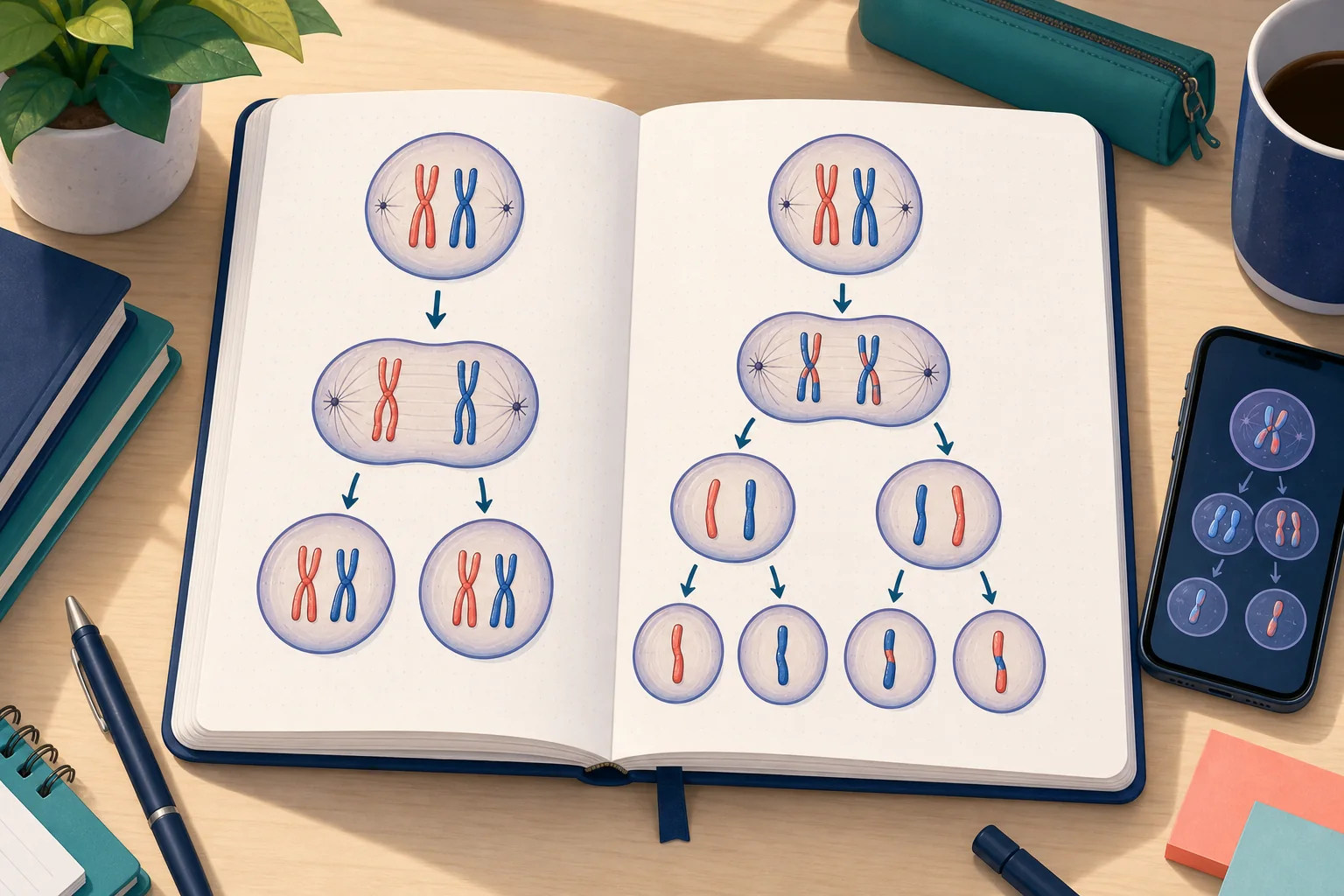
Mitosis vs meiosis is easiest to understand as a comparison of jobs and outcomes. Mitosis usually makes two daughter cells for growth, repair, or asexual reproduction while keeping the chromosome number the same. Meiosis uses two divisions to make haploid reproductive cells, reduces the chromosome number by half, and creates genetic variation.
Do not begin by memorizing eight stage names. First track what is separating: sister chromatids separate in mitosis, homologous chromosome pairs separate in meiosis I, and sister chromatids separate in meiosis II. That one question explains most diagrams, tables, and exam prompts.
1. Start the mitosis vs meiosis comparison with the outcome
Make four columns: purpose, number of divisions, chromosome number, and products. Mitosis has one nuclear division and generally yields two cells with the same chromosome number as the parent. Meiosis follows one DNA replication with two divisions and generally yields four haploid products.
The word ‘identical’ needs care. School comparisons describe mitotic daughter cells as genetically identical to the parent and each other, apart from mutations. Meiotic products differ because homologous chromosomes assort independently and crossing over can exchange DNA between homologs.
- Mitosis: one division, usually two similar daughter cells
- Meiosis: two divisions, usually four varied haploid products
- Mitosis maintains chromosome number
- Meiosis halves chromosome number
2. Separate chromosome number from DNA amount
A chromosome is counted by its centromere, not by the number of visible arms. After DNA replication, one chromosome contains two sister chromatids but is still counted as one duplicated chromosome. This is why an X-shaped chromosome is not automatically two chromosomes.
Both processes are preceded by DNA replication in S phase. There is no second round of replication between meiosis I and meiosis II. When sister chromatids separate, each chromatid becomes an individual chromosome. Keep chromosome count, chromatid count, and ploidy on separate lines.
Ask three different questions: How many chromosome sets? Has DNA replicated? What structure separates next?
3. Follow mitosis as one chromosome-preserving division
In prophase, duplicated chromosomes condense and the spindle forms. In metaphase, individual duplicated chromosomes line up at the cell equator. In anaphase, sister chromatids separate toward opposite poles. Telophase and cytokinesis complete two daughter cells.
The biological job helps identify the process. Growth, replacement of damaged cells, and many forms of asexual reproduction point toward mitosis. If a diagram begins with a diploid cell and ends with two diploid cells, the chromosome number has been maintained.
- Prophase: chromosomes condense
- Metaphase: duplicated chromosomes align individually
- Anaphase: sister chromatids separate
- Telophase and cytokinesis: two cells form
4. Follow meiosis as reduction followed by separation
Meiosis I is the distinctive division. Homologous chromosomes pair during prophase I, and crossing over may occur between nonsister chromatids. Homologous pairs align in metaphase I and separate in anaphase I; sister chromatids remain joined. The products are haploid even though each chromosome is still duplicated.
Meiosis II resembles mitosis because chromosomes align individually and sister chromatids separate. However, it starts with haploid cells and no new DNA replication. The common classroom endpoint is four haploid, genetically different cells; real gamete formation can yield unequal functional products.
Meiosis I separates homologs; meiosis II separates sister chromatids.
5. Read diagrams and number questions without guessing
Mark the parent cell and count homologous pairs by color, size, or labels. Paired homologs at the equator indicate metaphase I, while individual duplicated chromosomes suggest mitosis or meiosis II. At the next frame, identify whether homologs or sister chromatids move apart.
For a species with 2n = 8, a typical mitotic daughter cell remains 2n = 8. A meiotic product is n = 4. Do not halve the chromosome number again in meiosis II. If a question asks about DNA amount, create a separate timeline and use the convention supplied by the teacher.
- Find the starting ploidy
- Identify paired homologs or individual chromosomes
- Name what separates
- Check final cell number and ploidy
6. Fix the mistakes that make the stages blur together
A frequent error is saying DNA replication happens before both meiotic divisions. It happens once before meiosis I. Another is saying crossing over occurs whenever chromosomes separate; the standard school answer places it in prophase I, after homologous chromosomes pair.
Homologs carry the same categories of genes but may contain different alleles and come from different parents. Sister chromatids are replicated copies of one chromosome. Draw homologs as matching sizes in different colors, then join sister chromatids at one centromere.
Replace a memorized stage name with: ‘these structures separate, so this result follows.’
7. Use Lirno to scan, explain, and quiz the comparison
Photograph the complete worksheet, including legends, chromosome colors, and your attempted labels. In Lirno, confirm the scan and ask the AI tutor to identify only the first frame where your mitosis vs meiosis classification stops matching the chromosome behavior. Keep the final labels hidden while you correct the diagram.
Then make a quiz or flashcards contrasting homologs with sister chromatids, metaphase I with mitotic metaphase, and chromosome number with DNA amount. AI can misread a diagram or simplify a course convention, so compare the explanation with class notes and follow school rules for graded work.
- Scan the whole diagram
- Confirm symbols and color key
- Ask for one bounded hint
- Correct on paper and retest without notes