
Homework help
AI homework checker: find the first mistake, then fix it
Use AI feedback to inspect your own work, locate the earliest mismatch, repair the reasoning, and turn one mistake into useful practice.

An AI homework checker is most useful before you erase your work or ask for a finished answer. You already have valuable evidence on the page: the method you chose, the point where your reasoning changed direction, and the parts you can complete independently. The goal is to find the first meaningful mismatch, understand why it happened, and make the correction yourself.
That approach works across equations, science explanations, essays, and language exercises. It also avoids a common trap: replacing an imperfect attempt with a polished response that teaches you nothing about your own mistake. This guide gives you a repeatable check loop for Lirno or another permitted study tool: capture the full task, verify the input, request the smallest useful feedback, revise on paper, and turn the error into a short practice prompt.
1. Decide what you want the AI homework checker to inspect
Start by naming the kind of check you need. A correct final value can come from faulty reasoning, while a wrong final value may follow an otherwise sound method with one arithmetic slip. In an essay, accurate facts do not guarantee that the paragraph answers the prompt. In a language exercise, grammatical wording may still use the wrong tense for the task. Asking only ‘Is this right?’ hides those differences.
Choose one target: task interpretation, method, individual steps, evidence, units, grammar, or final result. Then write a specific request such as ‘Check whether each transformation stays equivalent and identify only the first problem.’ A narrow question produces feedback you can act on. It also helps you decide what evidence to verify instead of treating every sentence from an AI system as equally reliable.
- Instruction check: did I answer what was asked?
- Method check: does this approach fit the problem?
- Step check: where does the reasoning first stop working?
- Result check: does the final answer satisfy the original task?
2. Capture the complete assignment and your own attempt
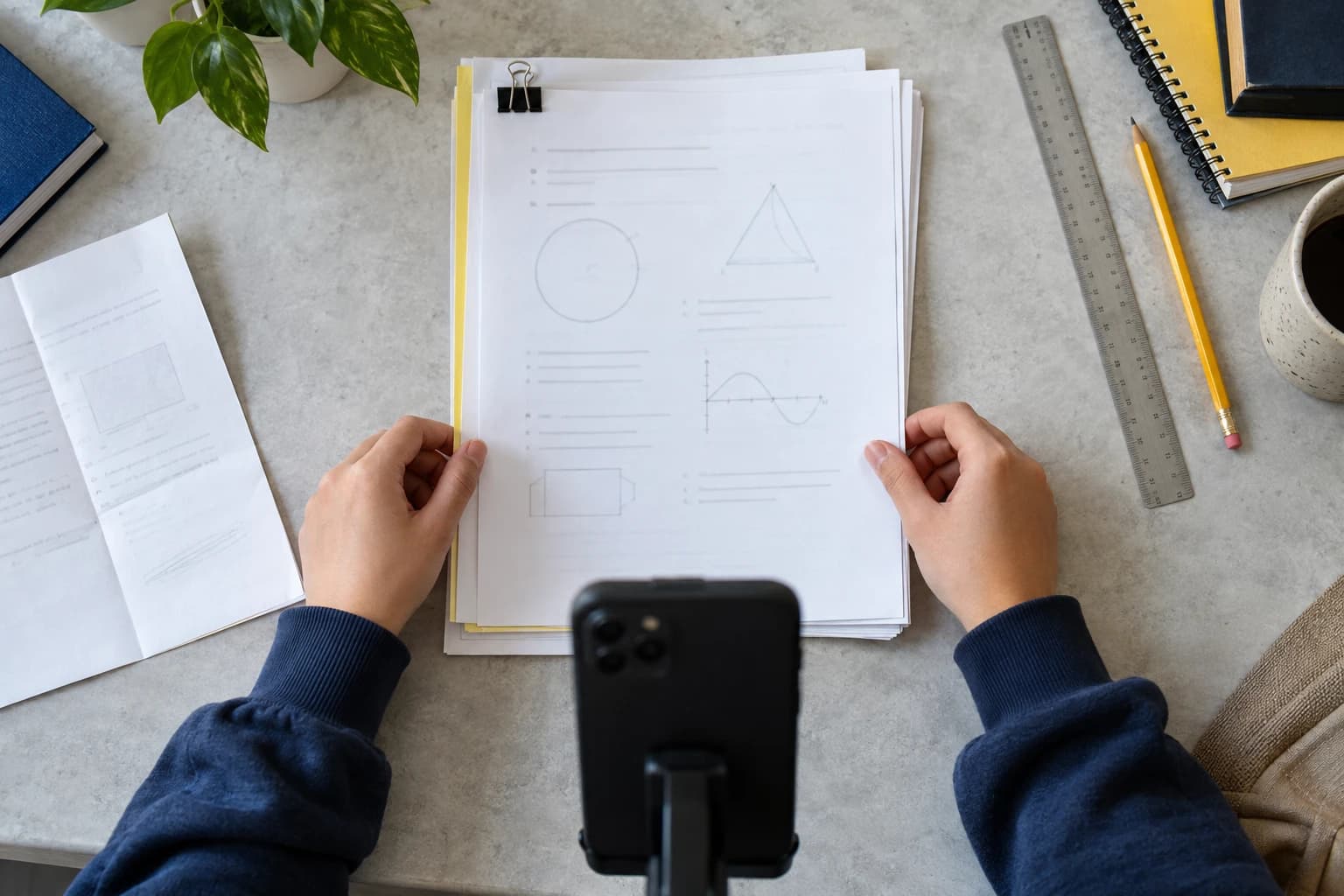
A cropped photo can remove the condition that changes the answer. Include the full prompt, diagrams, tables, answer choices, units, source requirements, and your attempted work. Use even light, keep the page flat, avoid shadows over small symbols, and take a second image when one photo cannot keep everything readable. The aim is not a beautiful scan; it is complete evidence.
After importing the image, compare the recognized task with the paper before requesting feedback. Check negative signs, exponents, fractions, chemical subscripts, accents, names, dates, and labels. If the scan changed one of them, correct the input or retake the photo. A clear homework scan preserves the context an AI tutor needs. Never continue from a transcription you already know is wrong.
Before asking for help, compare the digital input with the original page line by line. A checker cannot repair context that never reached it.
3. Ask for a check, not an invisible replacement
The most productive prompt protects your next attempt. Tell the tutor what you tried, what feels uncertain, and what kind of response you want. Ask it to keep the finished answer hidden, point to the earliest questionable step, or give one hint about the relevant concept. If you have not begun, ask for a starting question rather than a complete solution.
In Lirno, choose Check when you have work to inspect, Hint when you need a small nudge, and Explain when the underlying idea is unclear. Quick can be useful for a concise clarification, but it should not replace your verification. A useful prompt is: ‘Read the full task and my attempt. Tell me whether the method fits, then identify the first line I should reconsider. Do not finish the problem for me.’
- State the exact uncertainty
- Request one type of feedback
- Keep the final answer hidden when possible
- Write the next step before asking again
4. Find the first mismatch instead of collecting every correction
Read your work from the beginning and compare each line with the one before it. The first mismatch matters more than the final cluster of symptoms. A sign error can change every later number; a weak thesis can make every supporting paragraph feel unfocused; a misread command word can send an entire science response in the wrong direction. Fixing later details first wastes effort because they may disappear after the earliest repair.
When the checker flags a line, ask what rule connects it to the previous line. Then test that rule with your notes or a small example. Do not accept a correction merely because it sounds confident. The Education Endowment Foundation's overview of effective feedback emphasizes that feedback must be used by the learner; information alone does not produce improvement.
Circle the first line you cannot justify. Later errors are often consequences, not separate problems.

Read the Education Endowment Foundation overview of effective feedback
5. Repair the line yourself and explain the reason
Close or cover the suggested continuation. Rewrite the line on paper, including the operation, rule, evidence, or grammar choice that makes it valid. Then explain the repair in one sentence without copying the AI wording. If you cannot explain it, you have located a concept gap rather than completed a correction. Request one narrower explanation and return to your own page.
Next, continue at least one step independently. This prevents the checking session from becoming a sequence of approvals where the tool does the thinking between every line. Use Lirno Tutor for a hint, explanation, or targeted check, but keep your working page as the source of the final response. Lirno is designed to support the attempt, not to certify that an answer is correct.

6. Check mathematics and science without trusting the final number
For mathematics, verify that each transformation preserves equality, every denominator stays valid, and all candidate solutions work in the original expression. Estimate the sign and size before calculating. Units provide another independent test: metres cannot become square metres without a reason. A graph, table, or substitution can reveal an answer that is numerically neat but conceptually impossible.
For science, separate calculation from explanation. Check the formula, values, units, significant figures, and final interpretation individually. For a written response, identify the claim, evidence, and reasoning that connects them. AI may invent a relationship, misread a diagram, or state a plausible fact that does not answer the question. Compare feedback with the textbook, lab instructions, and teacher approved references before revising.
- Predict a sensible range before calculating
- Check symbols and units against the prompt
- Substitute or test the result independently
- Confirm that the explanation answers the stated question
7. Check writing by criteria, not by how polished it sounds
A fluent paragraph can still miss the assignment. Paste or capture the rubric with your draft and ask the checker to map each criterion to visible evidence in your text. Request questions about weak places before accepting rewritten sentences. For example: ‘Where does this paragraph stop supporting my thesis?’ is more useful than ‘Make this better.’ It shows which decision you need to make.
Keep ownership of the language. Mark any suggested claim that introduces information you did not research, and confirm every quotation, citation, date, and source yourself. For language homework, ask which rule a correction uses and create a second sentence with the same pattern. Style is not proof of accuracy, and a generated citation can look convincing while pointing to a source that does not exist.
- Match every paragraph to the prompt or rubric
- Verify claims and citations at their original sources
- Preserve your own voice and course level
- Practise the corrected language pattern in a new sentence
8. Turn the mistake into one small retrieval task
A corrected page feels finished, but recognition is not the same as recall. Convert the precise mistake into one flashcard, quiz question, or near transfer problem. The front should cue the decision you missed, not display the original answer. For example, ask ‘What must I check before dividing both sides by an expression?’ or ‘Which sentence in a paragraph should connect evidence back to the claim?’
Try the prompt later without notes or AI. If you answer correctly, vary one feature and try again. If not, return to the explanation, then shorten it into your own words. Add the practice to a realistic study block rather than making a giant deck you will never review. This is where homework feedback becomes durable learning instead of a one time repair.

9. Verify AI feedback with a second source and your school rules
Generative AI can misread an image, omit a constraint, invent a citation, or produce confident reasoning that is false. Treat its response as a lead to inspect. Recalculate, reread the source, compare with class notes, or ask your teacher when a requirement remains ambiguous. Agreement between two AI answers is not independent verification because both may repeat the same common error.
Use only tools and data allowed by your school. Remove names, grades, addresses, login details, and other unnecessary personal information from images. UNESCO guidance on generative AI in education describes the need for human oversight, privacy, and age appropriate use. Lirno cannot guarantee correctness, grades, mastery, or permission to use AI on a particular assignment.
Verification rule: an AI response is feedback to test, not an answer key or a teacher's approval.
Review UNESCO guidance on responsible generative AI in education · Use AI for homework without replacing your own thinking
10. Use a repeatable AI homework checker routine
Keep the process short enough to use on an ordinary school night. First, attempt the task and mark your uncertainty. Second, capture the full prompt and your work. Third, verify the scan. Fourth, request a hint, explanation, or check that reveals the smallest useful next step. Fifth, repair the work yourself and test it against the original task. Finally, create one practice item or planning note from the mistake.
If the checker identifies many issues, do not chase them all at once. Sort them into one root concept, one execution slip, and one presentation detail. Work in that order. A misunderstood concept changes the method; an execution slip changes one step; presentation can wait until the reasoning is sound. This priority keeps feedback manageable and makes the next independent attempt more informative.
- Attempt and mark the uncertainty
- Capture and verify the complete task
- Request the smallest useful feedback
- Repair, check, and practise independently
11. Know when to stop checking and ask a person
Stop the loop when feedback contradicts the prompt, changes between identical questions, depends on an unreadable diagram, or requires a rule your class has not covered. Also stop when the assignment is an assessment where outside help is prohibited. Save the exact line, source, or instruction that caused the conflict so a teacher, tutor, or classmate can respond efficiently.
The successful outcome is not a green label from an AI homework checker. It is a revised answer you can defend, a check you performed independently, and a clearer decision for the next problem. When you can explain the first mistake and avoid it in a fresh example, the feedback has done its job. Submit only work that follows the assignment rules and remains genuinely yours.