
Responsible AI
AI for homework without cheating: a better help loop
Use AI for homework without handing over the thinking: check the rules, make an attempt, ask for the smallest useful help, verify it, and practise the idea yourself.

The best way to use AI for homework without cheating is to keep the decisions and the final work yours. Read the assignment and its AI policy, capture the complete question, make a first attempt, and ask for only the help you need: a hint, an explanation, or a check. Verify the response against class material, correct your own work, and finish by practising the idea without assistance.
This creates a useful boundary. AI can help you notice a missing concept or an early mistake, but it can also misread a photo, invent a source, or produce reasoning that sounds confident and is wrong. The workflow below uses Lirno as a tutor and practice partner, not as an invisible author. It works for a single worksheet question, a longer assignment, and exam preparation, while leaving room for the rules set by your teacher or institution.
1. Check what the assignment allows before opening AI
Start with the exact instructions, rubric, and course policy. AI may be allowed for brainstorming or feedback but not for generating submitted prose; another teacher may permit explanations but require disclosure. If the rule is missing or ambiguous, ask. A tool cannot grant permission on your teacher's behalf, and a generally useful workflow does not override a local policy.
Write a one-line boundary before you begin: for example, ‘I may use AI to clarify the concept and check my attempt, but I will solve and write the answer myself.’ This small decision prevents the session from drifting from support into substitution. UNESCO's guidance on generative AI in education also emphasizes human agency, appropriate use, privacy, and the need for institutional safeguards rather than uncritical adoption.
- Allowed use for this task
- Work that must remain entirely yours
- Whether AI assistance must be disclosed
- Material you should not upload

2. Capture the full task, not one convenient sentence
A cropped question removes the context that determines a good answer. Include the task verb, all subquestions, diagrams, tables, units, source extracts, and formatting requirements. For a photo or PDF, check that negatives, exponents, labels, and page order were recognized correctly. A clean scan of the wrong fragment still leads the tutor toward the wrong problem.
In Lirno, review the captured homework before starting a mission. Restate the goal in your own words: ‘I need to compare two causes using evidence,’ or ‘I need to isolate x and show each transformation.’ If your restatement does not match the prompt, fix that first. Understanding what is being assessed is part of the homework, not administrative preparation.
Useful check: what will the teacher be able to see in the finished work that proves I understood the task?
3. Make a first attempt, even when it is incomplete
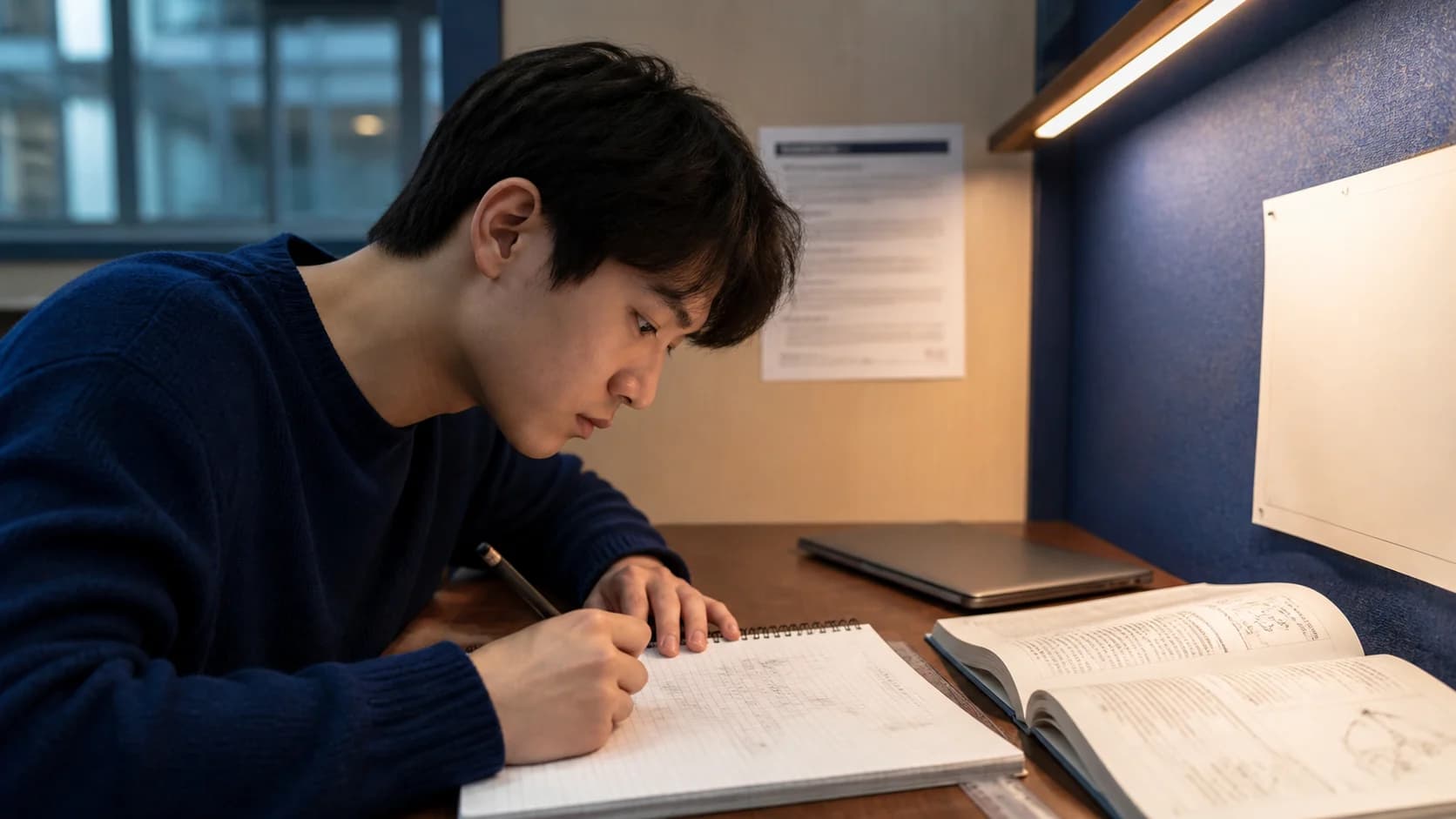
Spend a few minutes recalling the rule, drawing the diagram, writing a thesis candidate, or completing the first step. Mark exactly where confidence ends. A partial attempt gives an AI tutor evidence about your thinking and makes the response easier to evaluate. Without it, the easiest output to accept is often a complete answer that teaches you very little.
Your attempt does not need to be elegant. In mathematics, write the equation and one transformation. In science, name the principle and predict the direction of change. For an essay, list a claim and two possible pieces of evidence. The goal is to create a comparison point: after receiving help, you should be able to explain what changed and why.
- Recall before searching
- Show one reasoning step
- Mark the precise sticking point
- Keep the attempt visible while reviewing help
4. Ask for the smallest useful kind of help
Choose a request that preserves the next decision for you. Ask for a hint when you know the topic but cannot start, an explanation when the concept is unclear, and a check when you already have work. Avoid vague commands such as ‘do my homework.’ They invite a polished result without revealing which assumption, definition, or operation you need to understand.
Good prompts set a boundary and a stopping point: ‘Name the rule I need, but hide the answer’; ‘Check only my first two lines’; or ‘Ask me one question that will help me improve this claim.’ Lirno's Hint, Explain, Check, and Quick choices make the distinction visible. Begin with the least revealing option, attempt the next step, and ask for more only if the obstacle remains.
Prompt pattern: ‘Here is my attempt and where I am stuck. Give one clue, then wait for me to try again.’
See how Lirno Tutor separates hints, explanations, and checks
5. Verify what the AI thinks the problem says
Before judging the solution, compare the recognized task with the original. Look especially at minus signs, powers, denominators, chemical subscripts, dates, names, quotation marks, and graph labels. If the input is wrong, correct it or rescan. Continuing from a misread problem only produces more fluent detail around a false premise.
Then ask the tutor to state the goal, known information, and constraint without solving. This short summary exposes hidden assumptions. In a history question, it may reveal that two periods were confused; in a lab task, it may omit a controlled variable; in language work, it may mistake the required register. Fixing the model of the task is often more valuable than requesting another answer.
- Original and captured wording match
- All numbers, units, and labels are present
- The requested output is correctly identified
- No unstated assumption changes the task
7. Check claims, calculations, and sources independently
A confident tone is not evidence. Recalculate important results, substitute an answer back into the original problem, compare definitions with class notes, and open any cited source. Never cite a title, quotation, author, statistic, or link merely because an AI produced it. If the source cannot be found and read, it should not support your submission.
Use a two-pass review. First check factual fidelity: numbers, dates, formulas, quotations, and the strength of each claim. Then check reasoning: does the conclusion follow, were alternatives considered, and did a hidden assumption enter? Ask Lirno to point to one possible mismatch, but make the final judgment from the assignment materials and authoritative references.
- Recompute or reverse-check results
- Trace claims to readable sources
- Compare with the course method
- Treat unexplained certainty as a warning

8. Use different safeguards for different subjects
For mathematics and physics, request a concept or next operation, then calculate and verify every line. For chemistry, inspect symbols, charges, units, and conservation. In biology, separate an observed mechanism from a convenient analogy. A correct-looking final value can hide a method that your course does not use or a unit error that changes its meaning.
For essays, history, and languages, protect source accuracy and personal authorship. Ask for questions about your outline, not fabricated evidence. Check quotations in the original text, record page numbers, and distinguish paraphrase from your interpretation. In language practice, ask for an error category or a clue before a full correction, then rewrite the sentence and explain the rule aloud.
- STEM: show, calculate, and reverse-check
- Humanities: verify evidence and preserve interpretation
- Languages: identify the rule, then rewrite
- Creative work: keep choices, voice, and examples yours
9. Disclose assistance when the rules require it
Keep a short activity note while you work: the tool used, what you asked, what you accepted or rejected, and how you verified it. This is useful even when no formal declaration is required because it separates your decisions from generated suggestions. If the teacher provides a disclosure format, follow it exactly rather than inventing a vague sentence.
A concise disclosure might state that an AI tutor was used to clarify a concept and check an early draft, while the reasoning, source verification, and final wording were completed by you. Do not claim ‘no AI used’ after relying on it, and do not list it as a factual source. Assistance and evidence serve different roles.
Transparency is not a substitute for permission: an activity can be disclosed and still be outside the assignment rules.
10. Turn the explanation into practice before finishing
Receiving a clear explanation can feel like learning even when you cannot reproduce it. Close the help and solve a similar problem, teach the concept in plain language, or answer two retrieval questions. If you get stuck at the same point, request a smaller clue and try again. The aim is independent performance, not familiarity with a polished walkthrough.
Lirno can turn the understood idea into flashcards, a short quiz, or a study plan. Keep questions focused on the concept rather than memorizing the exact homework answer. Mix one direct recall item with an application and an error-finding item. Schedule a brief review later so the session produces knowledge that survives beyond submission.
- Explain without looking
- Solve a changed example
- Find and correct a deliberate error
- Review again after a delay

Build a practice quiz that tests recall instead of recognition
11. Protect private and school information
Remove full names, student numbers, email addresses, grades, private feedback, and details about other students before uploading a page. Do not share school accounts, unpublished exam material, health information, or documents you do not have permission to process. Crop to the necessary question when context outside it contains personal data.
Think about ownership as well as privacy. A textbook passage, paid worksheet, classmate's work, or teacher-created assessment may have usage restrictions. Use the minimum material needed for legitimate study support. When uncertain, describe the concept in your own words or ask the teacher rather than uploading the document.
- Remove identifiers
- Upload only necessary material
- Do not expose another person's work
- Follow school and platform privacy rules
12. Run the final honest-submission check
Before submitting, put the AI output away and read the assignment beside your work. Confirm that every requirement is answered, every source exists, every calculation can be repeated, and every sentence represents your understanding. Correct any passage you cannot explain. If the permitted-use boundary changed during the session, remove or redo the affected work.
Finish with a short teach-back: state the central idea, demonstrate one key step, and name one mistake you now know how to avoid. Then save any required activity record and plan a later review. Responsible AI use is not measured by how little typing you did; it is measured by whether the tool left you more capable of doing the next task yourself.
Submit only work you understand, can verify, and are allowed to produce with the help you used.