
Reading homework
Reading comprehension worksheet: find evidence before AI
Work from the full passage to a supported inference, then use a narrow hint or check without surrendering your own answer.

Your reading comprehension worksheet asks why a character changes their mind, but the passage never says it outright. You can quote a sentence, yet it is unclear whether that sentence actually supports your idea. Asking an AI tool for the finished answer may produce a fluent paragraph that refers to the wrong scene or invents a motive. The useful task is smaller: identify what the question asks, find relevant clues, and explain the connection yourself.
This guide follows one complete worksheet from first read to a short evidence-based response. Lirno can help capture the full passage, offer a hint, explain an unfamiliar reading move, or check a draft after you try. It is free to download or start, though some AI usage levels or advanced features may require Premium. Free reading comprehension help should leave you better able to read the next passage without a tool, and it must respect your school’s rules for outside assistance.
1. Read the question before asking a tutor
Circle the command word and the object of the question. ‘Find’ may ask for a detail stated in one place. ‘Explain’ or ‘Why’ usually asks you to connect details. ‘Evaluate’ may ask how convincing a narrator or argument is. Write a six-word version of the task in your margin, such as ‘why does the character refuse?’ A general plot summary will not answer that specific question, even if it proves you finished the passage.
Read the surrounding paragraph once without searching for the answer. Note who speaks, when the scene happens, and whether the narrator reports a fact or a character’s belief. Then put a small mark beside one sentence that might matter. Do not ask Lirno to interpret yet. A first independent look gives you something to test later and makes it easier to notice when an AI reply sounds plausible but drifts away from the actual wording of the assignment.
2. Capture the entire reading comprehension worksheet
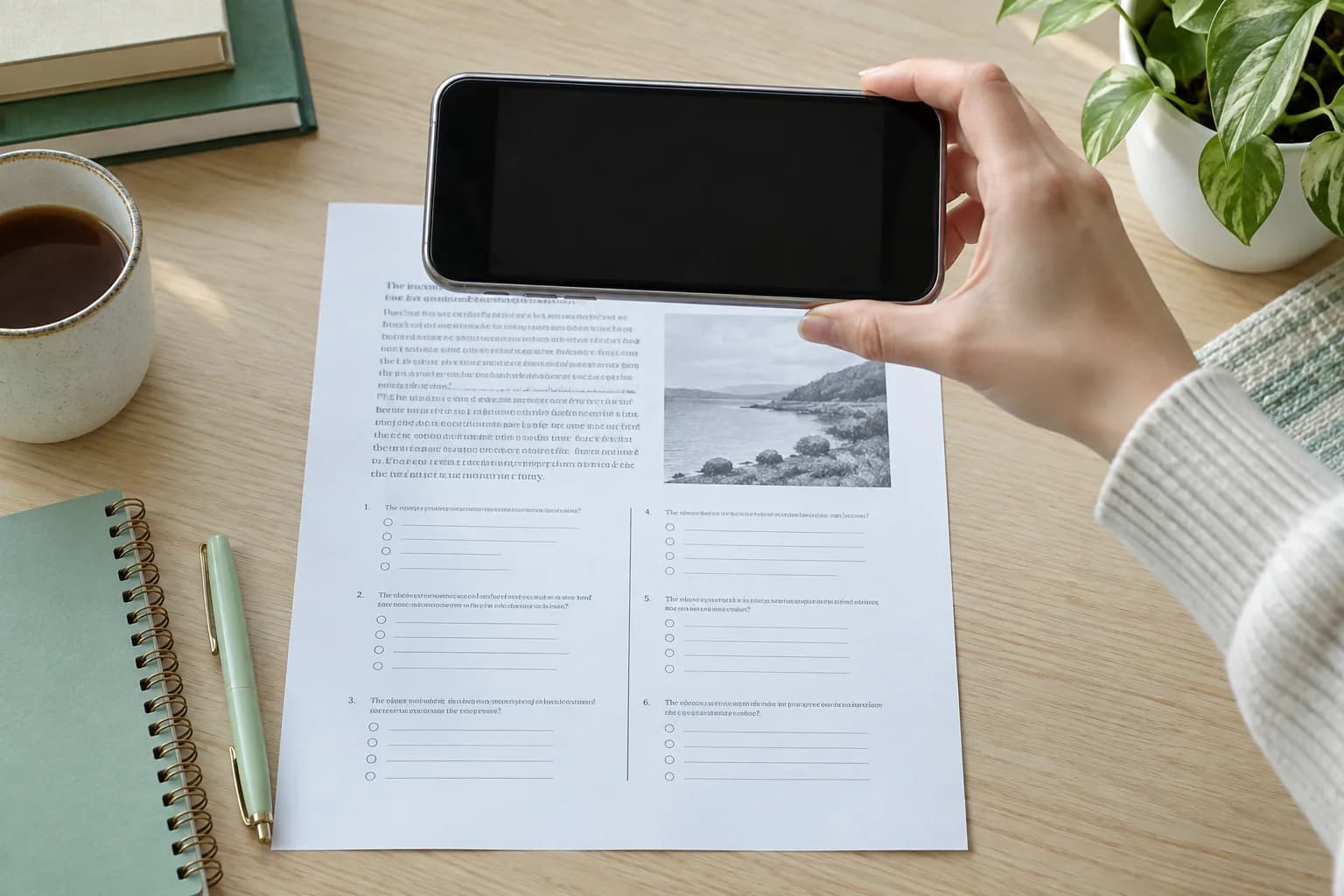
A useful scan contains the complete passage, title, question, answer options if present, paragraph breaks, and page numbers. If the text spans pages, capture them in order and include the end of one page with the beginning of the next when a sentence crosses the boundary. Flatten the sheet, avoid glare, and keep the camera square. A cropped photo can remove the sentence that changes the meaning of an inference or the word ‘except’ in a multiple-choice question.
In Lirno, capture the task, then compare what the app read with the printed source. Check character names, pronouns, negatives, quotation marks, and the exact question. Small OCR mistakes can reverse a claim: ‘did not leave’ is different from ‘did leave’. If a line is blurred, retake that page or type the uncertain phrase yourself. The scan is input, not evidence of its own accuracy. Keep the original passage beside you for every later check.
3. Classify the question before searching for a clue
Some questions are literal: the passage states a place, date, or action directly. Others combine information from two lines, perhaps a promise early in the story and a decision later. An inference question asks what those details suggest without saying it explicitly. A question about your own opinion is different again; it may allow background knowledge but still asks you to distinguish your view from the text. Naming the type saves time because each requires a different kind of support.
Reading Rockets describes a question-answer relationship strategy that separates answers found in one spot from those assembled across the text or connected to prior knowledge. Use it as a diagnostic tool, not a formula to memorize. For our question about a changed decision, look for an earlier plan and a later event that could explain the shift. If the passage offers no such clue, do not invent a motive merely because the worksheet expects a full sentence.
Review Reading Rockets' question-answer relationship strategy
4. Put literal details and inferences in separate columns
Make two short columns. On the left, record only details you can point to: a character closes a letter, mentions a deadline, and later avoids a meeting. On the right, write possible interpretations: perhaps the letter changes the character’s priorities. An interpretation is not a hidden quotation. It earns support by explaining how at least one left-column detail makes it plausible. If several explanations fit, choose the one with the strongest textual support and acknowledge any meaningful ambiguity.
Do not mistake an emotional label for proof. ‘She is afraid’ may be a reasonable inference, but the evidence might be that she checks the door twice and speaks in a whisper. Describe those actions first. In informational text, a claim may depend on a contrast, cause, or qualification across paragraphs rather than character behavior. Mark the connector that links the ideas. This habit helps prevent a polished AI sentence from replacing the actual close reading the question was designed to test.

5. Make an answer attempt before choosing help
Write a provisional answer in your own words, even if it is only one sentence. Add a margin note pointing to the phrase or paragraph that supports it. If you have two possible readings, write both and state what evidence would distinguish them. This attempt reveals the exact obstacle: perhaps you cannot locate the second clue, perhaps you understand the clue but cannot explain its significance, or perhaps the question wording itself is unclear.
Resist copying the longest sentence in the passage. A quotation without reasoning can fail an inference question, while an unsupported opinion can fail a textual-evidence question. Your first draft might be imperfect; that is useful information. It lets a teacher, classmate, or tutor respond to your reasoning rather than supply a generic answer. Keep the original version long enough to see what changed after feedback, and make sure any revision still sounds like you.

6. Ask Lirno for the smallest useful kind of help
After checking the scan, choose Hint if you need one place to inspect, Explain if you do not understand a concept such as inference or narrator viewpoint, or Check if you have a draft and want to test its evidence. A good hint request is: ‘Point me to one paragraph that may explain the decision; do not write the answer.’ A good check is: ‘Which sentence of my answer lacks support in the passage?’ These prompts preserve your role in forming the claim.
Read the reply against the printed page. If Lirno cites a line that does not exist, misnames a character, or treats a guess as a fact, correct the input or reject the suggestion. Do not send a page with names, grades, or private details you do not need to share. The app can be started for free, but that does not promise unlimited AI use. Whether a hint is allowed on this assignment depends on your teacher’s rules, not on the tool’s availability.
7. Match every inference to a visible phrase
Return to the passage with the candidate answer. Underline the exact words that support it and ask whether they support that interpretation more strongly than the alternatives. If the question asks ‘why’, one clue may show the action and another may show a reason; do not substitute a later consequence for the cause. If it asks about tone, identify a word choice or contrast, not merely the general mood you felt while reading.
The Common Core reading standards explicitly distinguish what a text says from inferences drawn from it and call for textual evidence in analysis. Your class may use a different curriculum, but the practical test is the same: could another reader find the detail you cite and follow the reasoning? Avoid overclaiming. ‘The character may distrust the message because she rereads it and delays answering’ is better supported than ‘She definitely knows the sender is lying’ when the passage never establishes that knowledge.
See the textual-evidence distinction in the English language arts standards
8. Write a compact response rather than a plot retelling
Build the answer in three moves: a direct claim, a precise detail, and one sentence explaining the link. In an illustrative story, you might say that the character hesitates because the new information conflicts with an earlier promise; you would then point to the relevant action or phrase and explain the tension. These are invented example details, not an answer to a real worksheet. Replace them with your passage’s words and follow any required citation format.
If the prompt asks for two pieces of evidence, give two distinct details rather than quoting one line twice. If it asks for a multiple-choice answer, test each option against the text: one may be true but unrelated to the question, one may reverse a negative, and another may add a fact from outside the passage. Explain why your chosen option fits the wording. A short, traceable answer usually demonstrates more reading than a long paragraph that circles around the story.
9. Turn the difficult move into new practice
Do not finish with the corrected worksheet. Identify the reading move that caused trouble: finding a direct detail, combining two clues, using a word’s context, or separating inference from invention. After the assignment is complete, make one short practice question from a different paragraph or a new permitted text. Hide the answer, locate the evidence, and explain your reasoning aloud before looking back. Repeating the same completed answer is a weak test of whether the skill transferred.
Lirno can help turn the tricky idea into a brief quiz or flashcards for later study. Keep the practice question separate from any graded answer, and verify that a generated question really matches the text. If it does not, rewrite it yourself. A useful card might ask ‘Which two phrases support this inference?’ rather than ‘What was the teacher’s answer?’ Record the paragraph location on the back so you can audit the evidence after recalling it.

10. Know when the passage or the rules need a human
Stop using a tool when the source is unreadable, a page is missing, a reference is unclear, or the suggested answer keeps changing after you correct it. Ask a teacher for the full passage or for clarification about what the question expects. For literature, several interpretations can be defensible; the assignment may be assessing the quality of your support rather than one secret answer. A tool cannot certify a grade, guarantee correctness, or decide whether AI assistance is permitted in your class.
Before submission, check that each claim belongs to the actual text, that quotation marks enclose exact wording, and that your explanation does more than repeat the quote. Keep a copy of your own first attempt and the evidence trail so you can discuss it if asked. The lasting method is simple but demanding: read the complete task, inspect the text, make a claim, find the clue, test the link, and then practise the move again. Lirno is useful only when it sharpens that reasoning.