
Math homework
Moments Homework: Find the Right Lever Arm
Solve moments homework by finding the perpendicular lever arm, balancing turning effects and checking a focused Lirno hint.

A beam balances on a pivot. A 12 N downward force acts 30 cm to the left, and an unknown downward force acts 20 cm to the right. You know that forces and distances belong in the calculation, but should the larger force go on the longer side? Moments homework becomes easier when you predict the turning effect before writing an equation.
The example assumes a horizontal beam with negligible weight, a fixed pivot and downward forces perpendicular to the beam. Those conditions matter. A heavy beam or an angled force needs extra information. Treat the example as a paper problem and follow your teacher’s instructions for any practical equipment.
Moments homework begins with the pivot
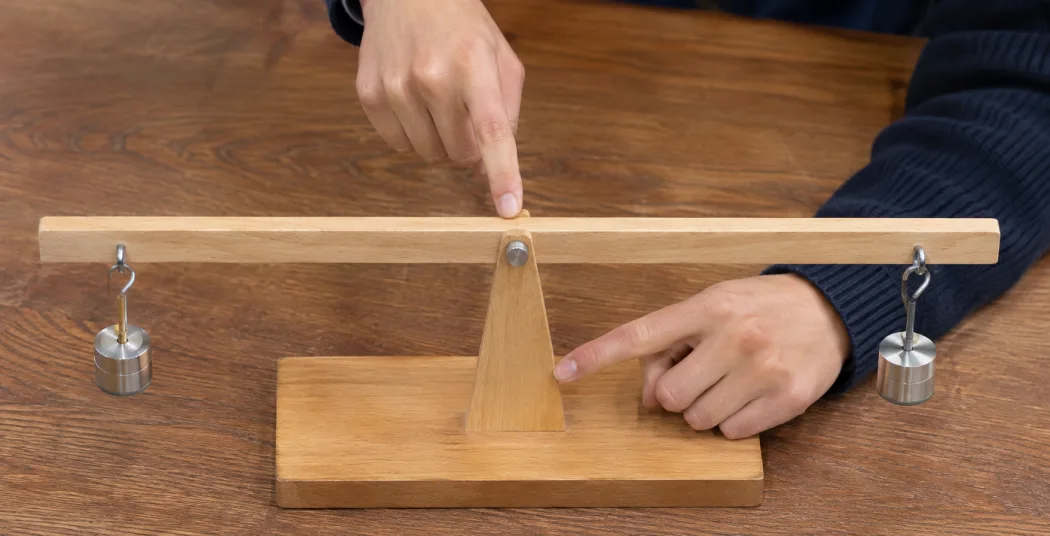
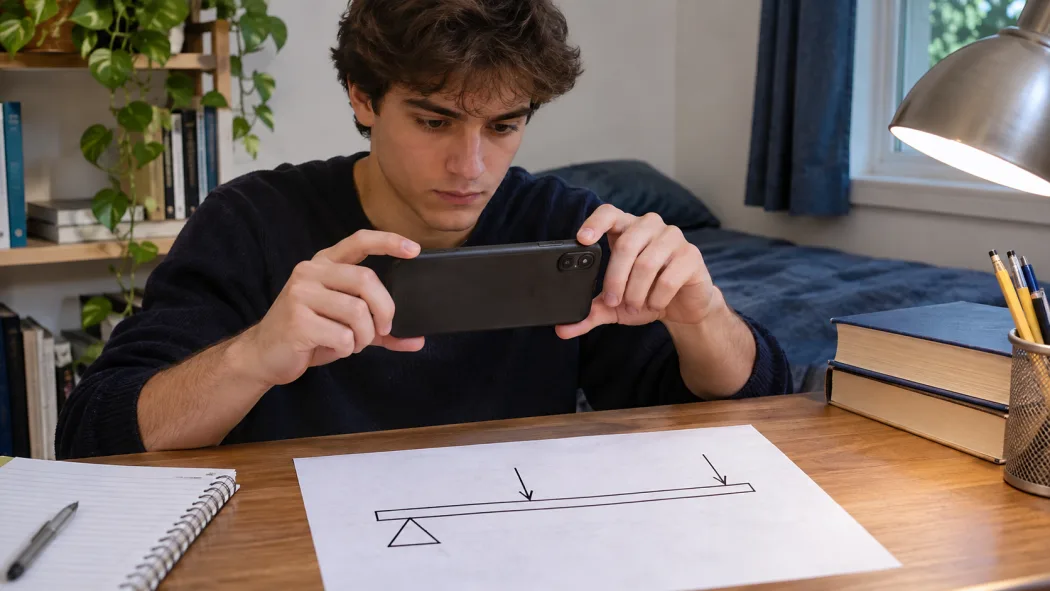
Mark the pivot on a simple sketch and add a downward arrow at each force location. Label each distance from the pivot to the relevant force line. The left downward force tends to lift the right side, turning the beam counterclockwise. The right downward force tends to lift the left side, turning it clockwise. Draw small curved arrows if the direction is hard to imagine.
For balance, those turning effects must cancel. A force farther from the pivot produces a greater moment when the force direction stays perpendicular. Since the unknown force acts closer to the pivot, it must be larger than 12 N to oppose the same moment. Write that prediction beside the sketch. It gives you a check that does not depend on the arithmetic.
Read the complete prompt before using the diagram. A drawing may not be to scale, and a distance label may run from one load to another rather than from the pivot. If the beam is described as uniform with a stated weight, you will need to include that weight at its center of mass. Only ignore a quantity when the stated model permits it.
Find the perpendicular distance to the force line
The magnitude of a moment is force multiplied by the perpendicular distance from the pivot to the force’s line of action. In a horizontal beam with vertical loads, the horizontal distances in the example are perpendicular to the forces. You can use 30 cm and 20 cm after converting both to meters. They become 0.30 m and 0.20 m.
Extend a force arrow into a straight line if you are unsure where to measure. Then draw the shortest line from the pivot to that force line. The little right angle identifies the lever arm. For a sloping force, the distance along the beam generally differs from this perpendicular distance. Do not use the full beam length merely because it is the only large number on the page.
The OpenStax explanation of rotational equilibrium shows why the perpendicular lever arm belongs in the calculation. Compare the force line and the right angle in its diagrams with your sketch. For this homework, identify that geometric distance first and calculate only after you know which length it represents.
Set opposite moments equal before inserting numbers
Write the balance condition as counterclockwise moment equals clockwise moment. For the example, that gives 12 × 0.30 = F × 0.20. The known moment is 3.6 N m. Dividing by 0.20 m gives F = 18 N. Put the unit with the answer and keep the unknown on the side of the diagram where it acts.
Now calculate the right-hand moment independently. Eighteen newtons multiplied by 0.20 meters gives 3.6 N m, matching the left. Eighteen newtons is also greater than 12 N, as your prediction required. A result of 8 N would fail that comparison even before you substituted it back into the equation.
If you use centimeters consistently on both sides while solving only for the force, the common distance conversion cancels. However, a moment reported in N m requires meters. Do not combine 30 cm on one side with 0.20 m on the other. For a clear method, convert every distance at the beginning and keep a short line showing the conversions.

Use a Lirno hint at the first uncertain step
If your school permits AI assistance, capture the whole assignment in Lirno. Include the text describing the beam, the pivot symbol, the distance labels and any statement about its weight. Compare the recognized task with the paper before using an explanation. A missed decimal, an unclear pivot or a distance assigned to the wrong side changes the model.
Try the sketch and a prediction yourself. If you are stuck, ask for a narrow hint such as “Which distance is perpendicular to the 12 N force? Leave the unknown force for me.” Use the hint to label the lever arm, write your own balance equation and solve it. If your answer differs from an explanation, ask about the first mismatching line rather than replacing the whole solution.
Check every suggestion against the stated conditions and your course notes. AI can misread a diagram or reason incorrectly, and school rules still apply. Lirno cannot guarantee correctness, grades, mastery or permission to use assistance. If uploading the task is restricted, use a self-written practice problem or work through the same steps on paper.
Separate turning balance from force balance
The two downward forces in the example add to 30 N. They do not cancel each other as vertical forces. The pivot must provide an upward force of 30 N under the stated negligible-beam-weight model. That upward reaction passes through the pivot, so its moment about that pivot is zero. A zero moment does not mean that the reaction force is absent.
A beam can have balanced turning effects while another condition of equilibrium still needs checking. For a static beam, both the resultant force and resultant moment must vanish. In the simple supported setup, the pivot reaction supplies the missing upward force. If the task asks only for the balancing load, you may finish the moment equation first and then use vertical balance as an additional check.
If the beam’s weight is included, add it to the force diagram. Its turning effect depends on where the center of mass lies relative to the pivot. A uniform beam supported at its midpoint has its weight line through that point, giving zero moment about it. With an off-center pivot, the same beam weight can produce a moment that belongs in your equation.
Handle several forces without guessing a single pair
Suppose a new diagram has two downward loads on the left and one on the right. Work out the moment of each load separately. Add the counterclockwise contributions and compare them with the clockwise contributions. Matching a single force on the left to the right-hand force would omit part of the turning effect.
Choose a sign convention if your class uses signed moments. You might take counterclockwise as positive and write the sum as zero. Keep the convention consistent throughout the calculation. A clockwise contribution then has a minus sign. Do not decide signs from whether a force arrow points upward or downward alone: the force’s position relative to the pivot also matters.
For a force whose line passes through the pivot, the perpendicular distance is zero. Its moment about that pivot is therefore zero even if the force is large. Mark the line of action so you can explain the omission. In a written solution, “zero lever arm” gives a reason. Silently leaving out an arrow can look like you forgot it.
Test the method on a new load position
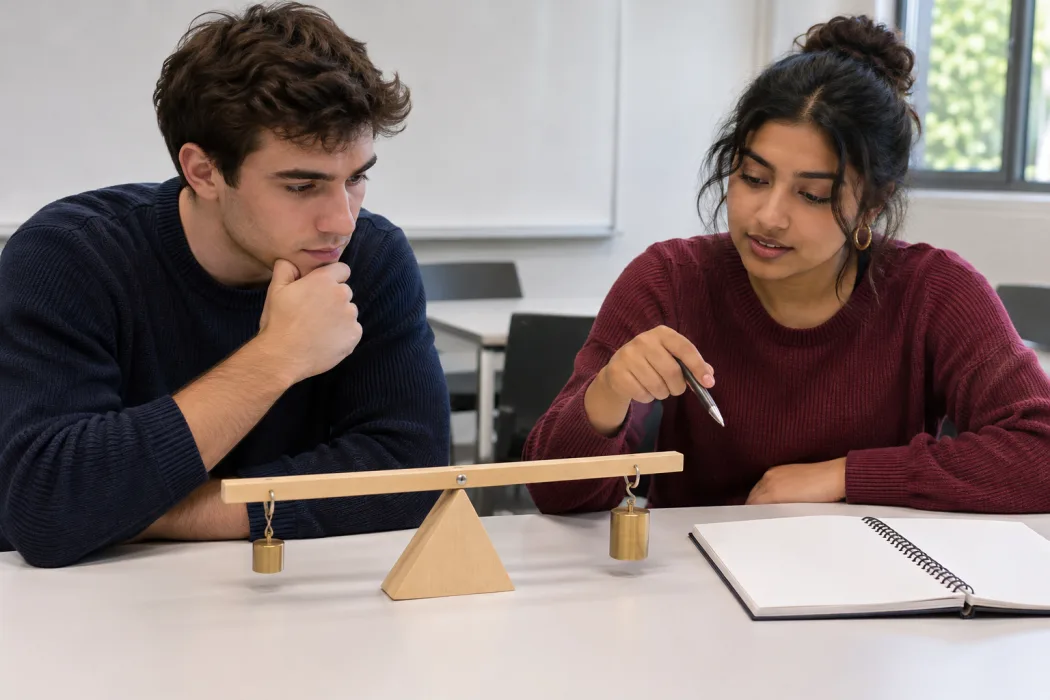
Return to the original 12 N load at 0.30 m. Move the unknown right-hand force to 0.40 m while leaving the left-hand side unchanged. Before calculating, predict that the unknown should now be smaller than 12 N because it acts farther from the pivot. The moment equation gives F = 3.6/0.40 = 9 N, consistent with that prediction.
Then keep the 0.20 m right-hand arm and double the left force to 24 N. The required right force also doubles, to 36 N. These are invented practice inputs, not measurements from equipment. They let you change one feature at a time and explain what the equation does. Cover the worked calculations and derive each result again from the sketch.
If an error keeps recurring, record the cause rather than only the final answer. The exam error log guide shows how to connect a correction to a later practice task. For this topic, useful causes include measuring from the wrong point, mixing distance units, ignoring beam weight or assigning the turning direction from the arrow alone.
Explain the answer using the diagram
A complete explanation connects the pivot, lever arms, turning directions and units. You could write that the 12 N force produces a counterclockwise moment of 3.6 N m, so the right-hand force must produce an equal clockwise moment. Because its lever arm is 0.20 m, the force is 18 N. The shorter arm requires the larger force.
Use a simple door example to test the idea in words. With the same perpendicular push, applying the force farther from the hinge increases the turning effect. If you push along a line through the hinge, the lever arm about it is zero. The geometry of the force line matters alongside the size of the push.
Choose a second problem from the guide archive after you can justify the first. Before submitting your homework, check that every distance is tied to a force line, every included load appears in the sketch and the final force passes the longer-arm comparison. Those checks give you a way to defend the method, even when the next drawing looks different.