Chemistry study
Mixtures and compounds: one phase is not proof
Separate substance identity from appearance, read particle models carefully and explain what a separation actually shows.

Mixtures and compounds are easy to confuse when an exercise shows only a clear liquid or a tidy particle picture. A uniform appearance does not establish that a sample contains one substance. Equally, seeing two physical regions does not automatically establish two substances. The useful question is what the sample contains and what evidence supports that claim, rather than whether it looks simple or complicated.
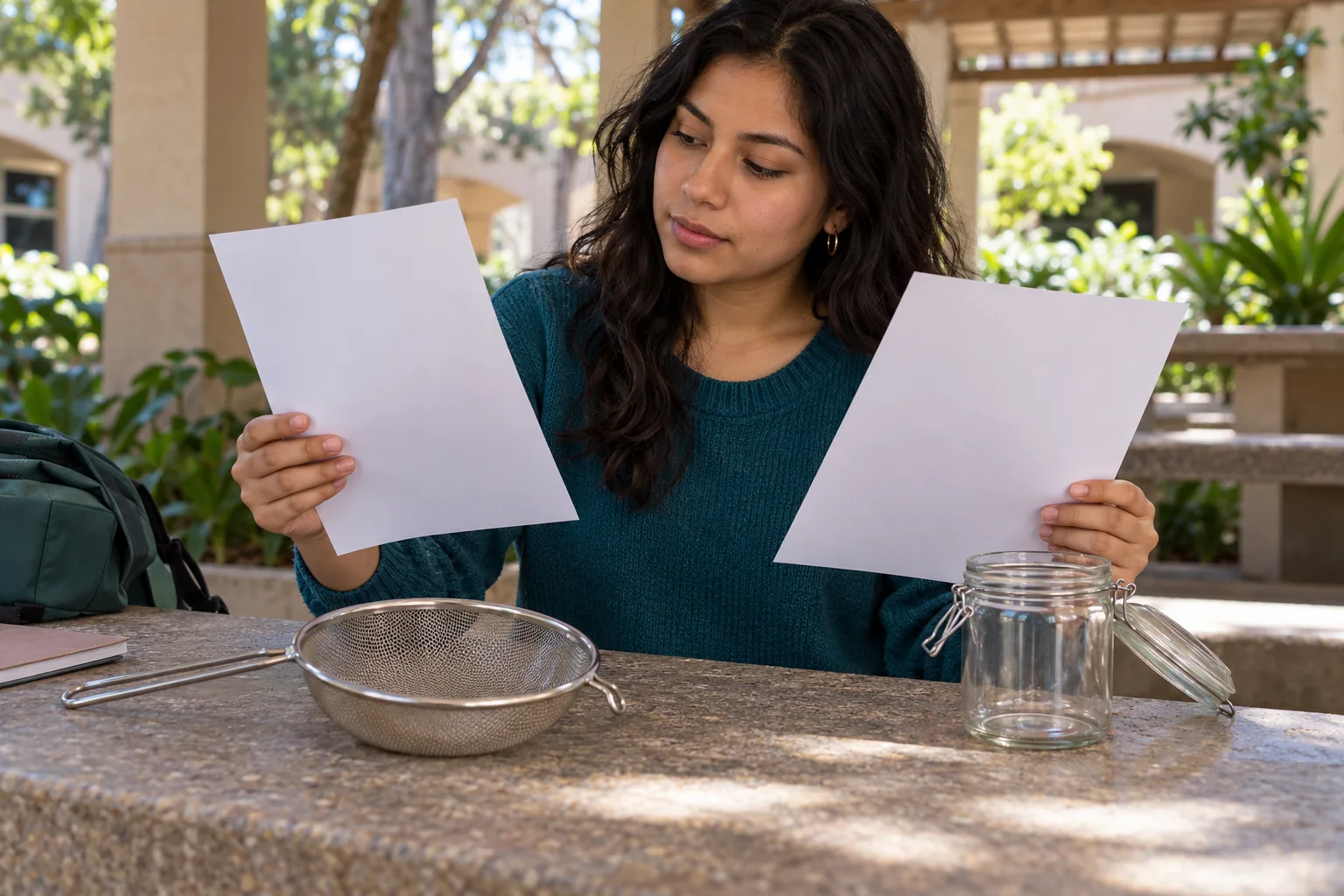
This guide gives you a reasoning method for classification questions, with original written cases and practice models. It distinguishes substance identity, chemical elements, composition and physical phases before discussing separation. The photographs illustrate study settings, not experiments or calibrated particle diagrams. Work from the information supplied by your task; a fictional classroom model can justify a definite answer even when a photograph of an unknown real sample cannot.
1. Classify mixtures and compounds at the right level
Start with the sample, not with the number of words in its name. In introductory chemistry, a pure substance has a defined chemical identity and composition. It may be an elemental substance or a compound. A mixture contains more than one substance. The question “pure substance or mixture?” therefore comes before “element or compound?” Calling a material a compound because it contains several kinds of atoms skips this essential first decision.
An elemental substance contains one chemical element; a compound contains different elements chemically combined in its characteristic composition. Pure nitrogen gas, N₂, is elemental even though its molecules contain two atoms. A pure sample of carbon dioxide, CO₂, is a compound even though every molecule can be the same. “One kind of molecule” and “one kind of atom” answer different questions. Keep these phrases distinct in your written explanation.
The OpenStax classification of matter places elements and compounds within pure substances and distinguishes them from mixtures. Use this hierarchy as a decision tree, not as a list of interchangeable labels. If an exercise says “pure CO₂,” its supplied identity is useful evidence. If it merely shows a colourless gas in a container, you cannot infer that identity from appearance alone. Record what is given separately from what you conclude.
2. Read the key before counting particle types
A particle diagram is a model with conventions. Read its legend: different colours may represent different elements, and a connecting line or explicit instruction may indicate a bond. Two circles drawn near each other are not necessarily bonded. Different circle sizes are not automatically different elements unless the key says so. Count the distinct represented chemical species or substances, rather than counting every individual circle as a separate component.
For an original model, let A and B represent two different elements, and let each written group represent one molecule. A box containing only AB molecules represents a pure compound. A box containing A₂ molecules together with B₂ molecules represents a mixture of two elemental substances. A box containing AB and AB₂ represents a mixture of two compounds. Having the same two element symbols in every box does not make these three classifications identical.
Not every compound consists of separate molecules. An ionic solid is often represented by an extended arrangement of ions, with a formula giving their ratio. Do not invent little NaCl molecules simply because a worksheet uses one formula unit for bookkeeping. When later balancing chemical equations, preserve the identities in the formulas and change appropriate coefficients instead. Counting atoms for an equation and counting substances in a sample are related skills, but they are not the same operation.

3. Count components and phases separately
A component in these school classification questions is a distinct substance in the system. A phase is a physically uniform region, such as a solid region or a liquid region. The counts need not match. In an idealised sample containing only H₂O as ice and liquid water, there is one chemical substance but two phases. The solid–liquid boundary does not turn water into a mixture of hydrogen and oxygen.
An idealised solution of sodium chloride in water, with all the salt dissolved, has two components and one liquid phase in the usual school description. If undissolved salt is also present, the same two components occupy a liquid solution and a solid phase. More visible regions have appeared without adding a new chemical substance. Specify the conditions described, because a different amount or temperature may change the phase situation.
This distinction corrects two opposite shortcuts: “one phase means pure” and “two phases means mixture.” Both fail on the examples above. The academic UNAM comparison of mixtures and compounds, in Spanish, provides a complementary discussion of composition and separation. Use a phase description to answer a phase question, and a composition description to answer a substance question. If the task asks for both, give both rather than substituting one count for the other.

4. Explain what a physical separation establishes
For a mixture, an appropriate physical separation can recover constituents without converting them into different chemical substances. The useful method depends on a relevant property difference. A filter that retains an insoluble solid can separate that solid from a liquid; it does not automatically remove substances dissolved in the liquid. A clear filtrate therefore need not be pure. State which constituent the supplied method can remove and which might remain.
Consider a fictional report saying that a solid is retained while a solution passes through a filter. The observation supports the presence of a separable solid in the original sample. It does not identify the solid, prove the filtrate contains only water or establish that every dissolved species was removed. A good answer separates what was observed from additional claims that would require identification or another suitable measurement. Do not turn the name of a method into an unlimited purity guarantee.
Removing water from a salt solution is different from decomposing water into its elements. Physical state changes do not, by themselves, change H₂O into hydrogen and oxygen. Chemical decomposition changes substance identity. These are distinctions to use when interpreting supplied classroom evidence, not instructions to heat, electrolyse or test unknown materials yourself. A separation that fails is also inconclusive: perhaps the method was unsuitable. Failure alone does not prove that the starting sample was a compound.
5. Distinguish a formula ratio from a mixture recipe
A compound formula communicates composition at the chemical level. CO₂ contains one carbon atom for every two oxygen atoms in its molecular model. That is a number ratio of atoms, not a statement that two thirds of its mass is oxygen. With the rounded classroom atomic masses C = 12 and O = 16, the oxygen contribution is 32 out of a total 44, or about 72.7% by mass. State the quantities being compared.
A mixture can have a specified recipe without becoming a compound. In an original paper example, 6 g of inert solid A and 14 g of inert solid B form a 20 g mixture, assuming no reaction or loss. The mass fraction of A is 6 ÷ 20 = 0.30, or 30%. Another batch with 9 g of A and 11 g of B is 45% A. The different recipe changes proportions, not necessarily the identities of A and B.
Conversely, one measured ratio from one sample does not prove chemical combination. A manufacturer can repeatedly prepare the same mixture proportions. To justify a compound classification, use the stated identity, an appropriate chemical model or other relevant evidence, rather than the mere existence of a ratio. Do not call the fictional A and B mixture homogeneous unless the problem supplies enough information about its spatial uniformity. Composition and uniformity remain separate claims.
6. Replace appearance shortcuts with evidence sentences
Take the statement “This clear drink is a pure substance.” Its weakness is that clarity describes visible appearance, not the absence of dissolved constituents. A better response is “The appearance alone does not establish purity; the drink may contain several dissolved substances.” You do not need to invent its ingredients to reject the inference. Distinguish proving a claim false from showing that the available evidence is insufficient to establish it.
Likewise, a material labelled “natural,” “mineral” or “pure” in everyday speech is not automatically a chemically pure substance. A commercial sample may include several substances. A school exercise explicitly specifying a pure element or pure compound supplies an idealisation you may use. Do not silently replace that stated model with guesses about contamination unless the task asks you to evaluate real experimental purity.
Characteristic properties can help compare a sample with a reference under matching conditions, but one result is not an unrestricted identity test. Temperature, pressure, measurement uncertainty and the possibility of different substances sharing a property matter. For a written classification, name the relevant observation, explain the chemical distinction it addresses, and state any remaining uncertainty. “It looks the same throughout” supports uniformity at the observed scale; it does not identify the substance or prove there is only one component.
7. Test the decision with four original cases
Case one explicitly states that every molecule is AB, with A and B different elements. Classify it as a pure compound, because one represented substance contains two elements chemically combined. Case two contains A₂ and B₂ without reaction. It is a mixture of elemental substances, not a compound merely because both elements occupy the same box. Your explanation should point to the different molecular species rather than to the drawing’s colourfulness.
Case three contains only H₂O, partly as ice and partly as liquid. The answer is one compound and two phases, not two substances. Case four shows a single unlabelled transparent liquid with no composition information. You can describe its visible uniformity, but cannot decide from that image whether it is a pure substance or a solution. “Insufficient information” is a reasoned conclusion when it identifies the missing evidence precisely.
Now change case one by adding some AB₂ molecules while leaving the AB molecules present. The box becomes a mixture of compounds. Changing the number of AB molecules alone would not do that. Explain this difference in a sentence: quantity changes how much of a substance is present; adding a different substance changes the composition category. These paper models simplify real materials, so keep their stated symbols and bonding conventions explicit rather than treating them as photographs of atoms.
8. Use a narrow check without surrendering the classification
Write your answer in three parts: classification, supporting evidence and a limitation where needed. For example, “Mixture: the model contains AB and AB₂ as distinct species. Its phase count is not specified.” This is more informative than “mixture because there are two colours,” which could equally describe a pure compound. Recheck that your sentence answers the requested level: substance type, elemental composition, phase count or separation evidence.
If school rules allow it, Lirno Tutor can help check a particular inference after you have made an attempt. Include the complete task, particle key and your explanation; verify any recognised symbols against the original. Ask “Does my evidence distinguish two substances from two elements?” or request a hint about one model. Avoid sharing names or unrelated private work. AI can misread a model and reason incorrectly, so compare its response with the task and a reliable source.
Lirno does not guarantee correctness, grades, mastery or permission to use AI. Follow your school’s rules. It is free to download or start; some AI usage levels or advanced features may require Premium. The reasoning and paper cases here work independently of an app. After checking a doubtful point, rewrite your own explanation and identify the evidence that would change your conclusion. That is the part you need to transfer to the next unfamiliar sample.