
Physics homework
Free physics homework help: draw force diagrams step by step
Use this free physics homework help to isolate an object, find every external force, draw a clean free-body diagram, and check it before writing equations.
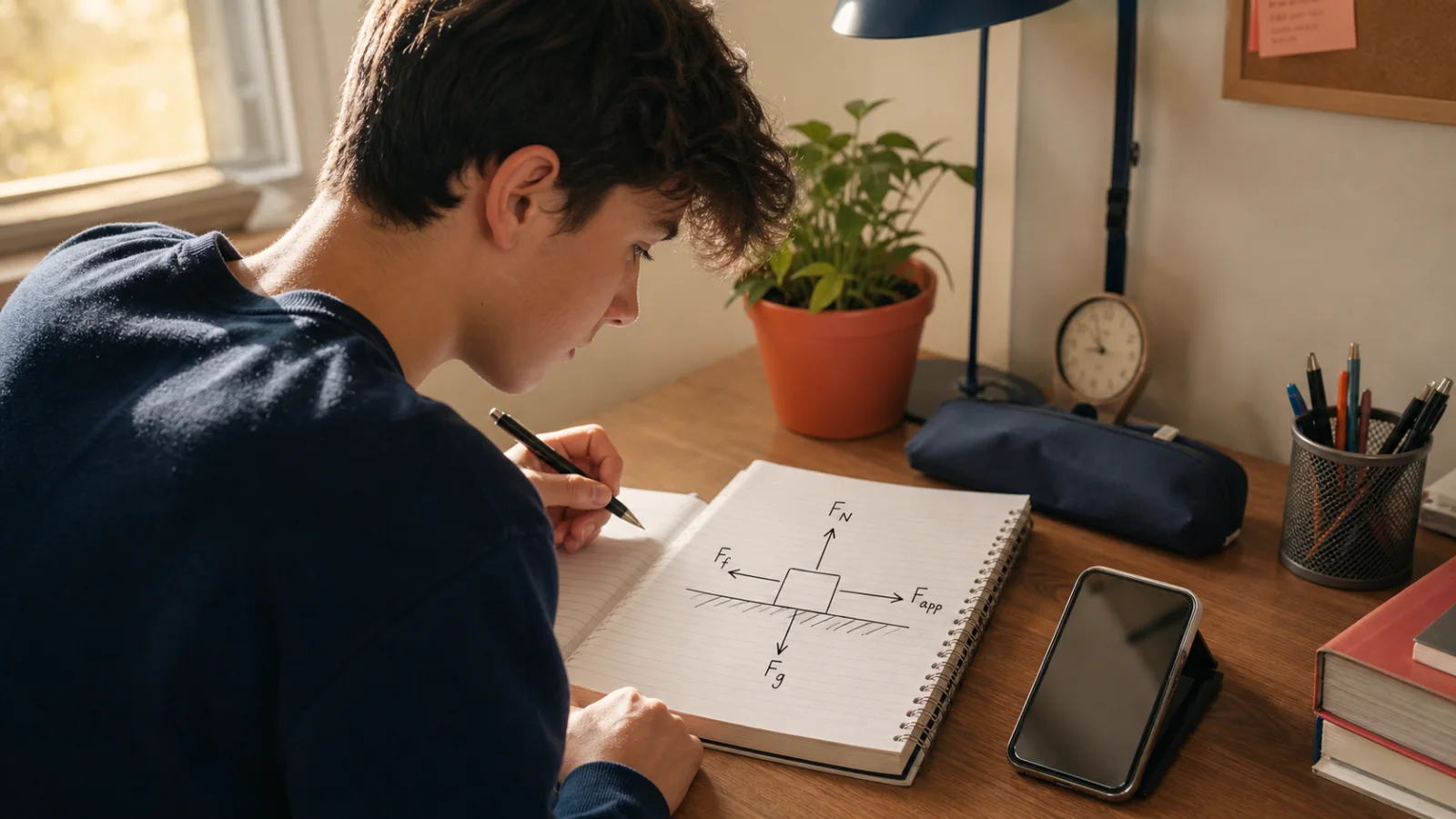
Free physics homework help should make the situation understandable before it produces an equation. For a force problem, isolate one object, list only the external forces acting on it, draw each force as a labelled vector, choose useful axes, and then apply Newton's law by direction. A correct free-body diagram turns a crowded picture into a small set of relationships you can test.
You can use the method below with paper and pencil for free. Lirno can also be downloaded or started for free: scan the complete question and your attempt, ask the AI tutor to check whether a force is missing, and repair the diagram yourself. Some usage levels or advanced tools may require Premium, so free does not mean unlimited use or guaranteed answers.
1. Start free physics homework help by choosing one object
Underline the object the question asks about: a book, block, hanging mass, cart, or connected system. Redraw it alone as a box or dot. Everything outside its boundary is the surroundings; only interactions that cross the boundary produce external forces on the chosen object.
With two blocks, draw a separate diagram for each unless the problem deliberately treats them as one system. A contact force is external to either block alone but internal to the combined system. Write the object's name above every sketch so a force cannot quietly migrate to the wrong diagram.
- Name the object or system
- Draw its boundary
- Separate bodies when needed
- Ask what acts on this object
2. Find forces from interactions
Begin with forces that act at a distance, usually weight near Earth's surface. Then inspect every contact: a surface may exert a normal force and friction, a taut string exerts tension, a spring exerts an elastic force, and a hand may apply a force. Name source and receiver: ‘the table pushes the book.’
Do not add a ‘force of motion.’ Velocity and acceleration describe motion but are not extra forces. Do not draw both members of a Newton's-third-law pair on one diagram either. The book's force on the table belongs to the table's diagram; the table's force on the book belongs to the book's.
For every arrow, complete: ‘the ___ exerts a force on the chosen object.’
3. Draw direction and label before calculating
Weight points vertically down. A normal force is perpendicular to the contact surface. Tension follows the string away from the object. Friction lies along the surface and opposes actual or impending relative sliding. Label every arrow; an unidentified arrow is impossible to audit.
Arrow length represents magnitude only when the information supports that comparison. Normal force is not automatically equal to weight: an angled pull, vertical acceleration, or extra contact can change it. The interaction determines direction, while the conditions and equations determine magnitude.
- Weight: toward Earth
- Normal: perpendicular to the surface
- Tension: along the string
- Friction: oppose relative slipping
4. Choose axes after the diagram
Axes are calculation tools, not forces. Horizontal and vertical axes suit a level surface; axes parallel and perpendicular to an incline often reduce the number of components. Mark one positive direction and keep the sign convention throughout the solution.
Resolve only vectors that are not already aligned. If weight is replaced by components, do not count the original weight again in the equations. Sketch the component triangle and ask which component should approach zero as the angle approaches zero; this catches many sine-and-cosine swaps.
Use either an original vector or its components in an equation, never both.
5. Turn arrows into Newton's-law equations
For each axis, the net force equals mass times the acceleration component. At rest or constant velocity, acceleration is zero, so forces balance by direction. Zero acceleration does not mean no forces act; it means their vector sum is zero.
For a block pulled right on a rough horizontal surface, a typical horizontal equation is applied force minus friction equals mass times acceleration. With no vertical acceleration and a horizontal pull, normal minus weight equals zero. Keep symbols until the model is settled, then substitute values with units.
- State the positive direction
- Write one equation per axis
- Use the motion condition
- Substitute values last
6. Audit the common mistakes
Frequent errors include drawing forces exerted by the chosen object, inventing a force in the direction of motion, assuming friction always exists, making normal force vertical on a slope, or treating normal force as automatically equal to weight. Every arrow needs a physical source.
Compare the diagram with the story. If the object accelerates right, the horizontal vector sum must point right. It can accelerate along a surface while having no acceleration perpendicular to it. Cover the original picture and explain every arrow aloud; investigate anything you cannot justify.
Audit in order: object, interactions, arrows, axes, motion condition, equations.
7. Use Lirno in a scan, hint and self-check loop
Photograph the complete question, including its picture, labels, values, and your attempt. In Lirno, first confirm that symbols and angles were read correctly. Ask a bounded question such as ‘Check only whether every external force on the block is shown; do not write the final equations.’ Then revise on paper.
A productive free physics homework help loop is scan, inspect, attempt, request one clue, repair, and verify. Lirno can also quiz you on which interaction creates each force or turn the weak point into flashcards. AI can be wrong, so compare with class notation, test the motion condition, and follow school rules for submitted work.
- Capture the whole prompt
- Confirm symbols and angles
- Request one bounded hint
- Make the next step yourself