
Chemistry homework
Moles and molar mass: a clear chemistry homework guide
Understand the mole, calculate molar mass, convert grams and particles, and check each chemistry result without copying an answer.

Free chemistry homework help is most valuable when it makes the units and relationships visible. Mole questions can look like a collection of unrelated formulas: grams become moles, moles become particles, and balanced equations introduce another ratio. In fact, the mole is the common bridge. Once you identify what the question gives, what it asks for, and which bridge connects them, most introductory calculations follow a short and checkable route.
This guide explains how to calculate moles from mass, convert moles back to grams, connect moles with particles, and use coefficients in a balanced equation. Every example keeps the units beside the numbers so you can see why a multiplication or division is valid. You can complete the method with a periodic table, calculator, and paper. Lirno is free to download or start if you want a hint or a check of your own working; some AI usage levels or advanced features may require Premium.
1. Read the chemistry question as a route between units
Before choosing a formula, write two labels: given and wanted. A question might give 36.03 grams of water and ask for moles. Another might give 0.250 moles of carbon dioxide and ask for mass. The numbers matter only after the units reveal the direction. Grams to moles requires molar mass; moles to particles requires the Avogadro constant; moles of one substance to moles of another requires a balanced chemical equation.
Underline the substance as well as the unit. One mole of oxygen atoms is not the same object as one mole of oxygen molecules, and their molar masses differ. Copy chemical formulas carefully, including subscripts and parentheses. Then sketch a route such as grams → moles → particles. If the requested unit is not at the end of your route, the setup is incomplete. This simple map prevents many formula-choice errors before arithmetic begins.
- Write the quantity and unit you are given
- Write the quantity and unit the question asks for
- Name the exact substance or particle
- Choose only the conversion factors needed to connect them
Start with units, not numbers: the unit you want should be the only unit left after cancellation.
2. Understand what one mole represents
A mole is a counting unit, just as a dozen means twelve objects. One mole contains exactly 6.02214076 × 10²³ specified entities. Those entities may be atoms, molecules, ions, electrons, or formula units, so a complete answer states what is being counted. The number is enormous because atoms and molecules are extremely small. Chemists use the mole to connect that microscopic count to measurable laboratory quantities.
The official SI definition fixes the Avogadro constant exactly. For school calculations, your course may round it to 6.02 × 10²³ or 6.022 × 10²³ per mole. Use the precision your teacher or data sheet provides. The important idea is proportionality: two moles contain twice as many specified particles as one mole, while half a mole contains half as many. Do not use the Avogadro constant when the task only converts between mass and moles.
3. Calculate molar mass without losing a subscript
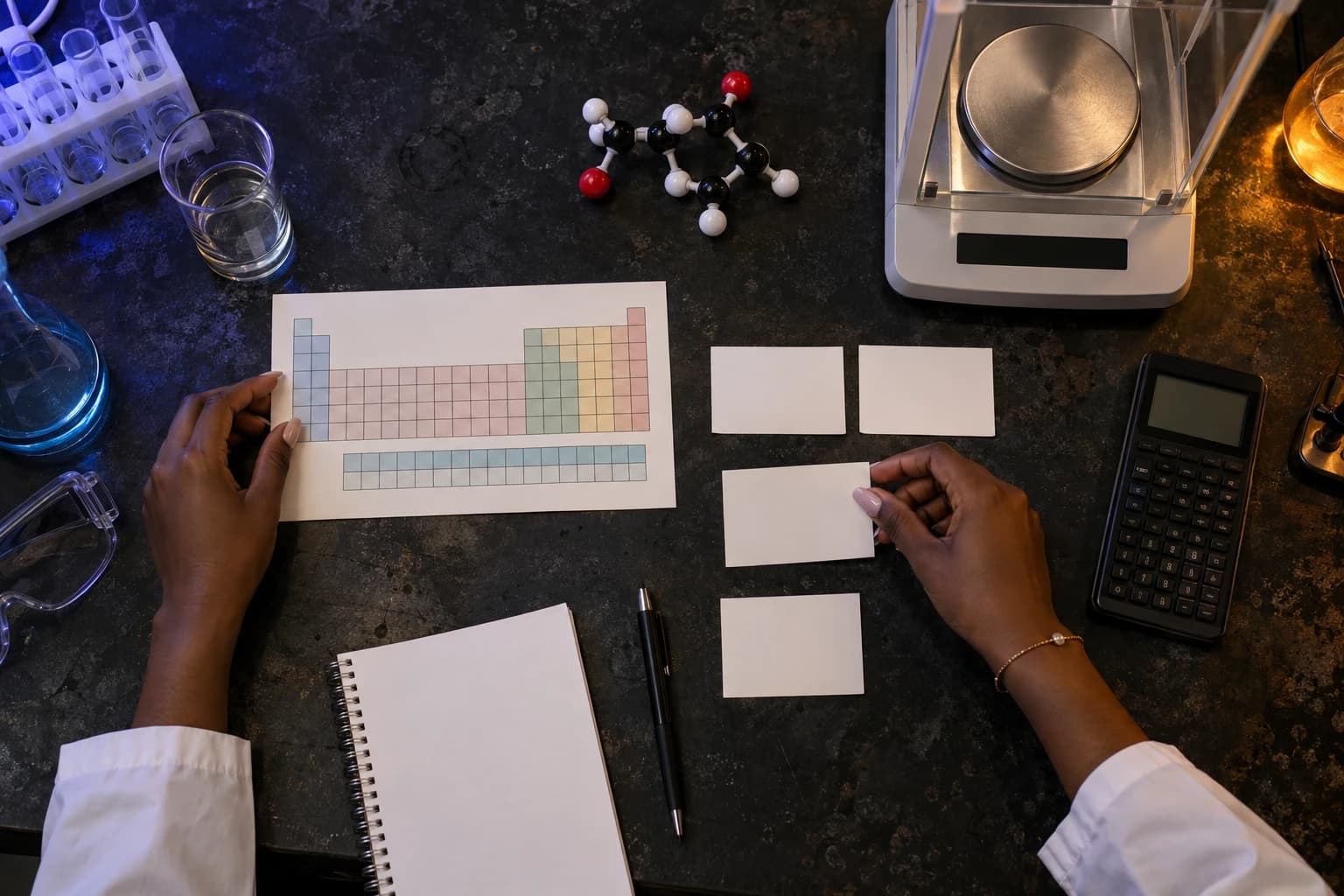
Molar mass tells you the mass of one mole of a substance, normally in grams per mole. For an element, use the atomic mass from the periodic table. For a compound, multiply each element's atomic mass by the number of its atoms and add the results. Water, H₂O, contains two hydrogen atoms and one oxygen atom, so its molar mass is about 2(1.008) + 16.00 = 18.016 grams per mole, often reported as 18.02 grams per mole.
Parentheses change the count. Calcium hydroxide, Ca(OH)₂, contains one calcium, two oxygen, and two hydrogen atoms. The outside subscript multiplies every atom inside the parentheses. Coefficients do not belong in molar mass: the 2 before H₂O in a balanced equation means two moles of water, but one mole of H₂O still has the same molar mass. Keep the formula and your atom count visible on separate lines before adding.
- Count every element in the chemical formula
- Apply subscripts and parentheses before adding masses
- Keep the unit grams per mole with the total
- Round only after the full molar mass is calculated
4. Convert grams to moles by dividing by molar mass
To convert a measured mass into amount of substance, use n = m ÷ M, where n is the amount in moles, m is the mass in grams, and M is the molar mass in grams per mole. Suppose a sample contains 36.03 grams of water. Using 18.015 grams per mole, the setup is 36.03 g ÷ 18.015 g/mol = 2.000 mol. The grams cancel, leaving moles.
Dimensional analysis makes the same step explicit: 36.03 g × (1 mol ÷ 18.015 g). Put the unwanted grams opposite each other so they cancel. If you accidentally multiply 36.03 by 18.015, the resulting unit would be g²/mol, which is not the requested unit. Unit cancellation therefore checks the operation before the calculator can produce a convincing but meaningless number.
Mass to moles: divide by molar mass. In a conversion-factor setup, place grams per mole underneath the given grams.

5. Convert moles to grams by multiplying
The reverse conversion uses m = n × M. For 0.250 moles of carbon dioxide, first calculate the molar mass: 12.01 + 2(16.00) = 44.01 grams per mole. Then 0.250 mol × 44.01 g/mol = 11.0025 g, which rounds to 11.0 grams when the given amount has three significant figures. The mole units cancel and grams remain.
A reasonableness check helps. If one mole of carbon dioxide has a mass of about 44 grams, one quarter of a mole should have a mass near 11 grams. A result of 176 grams would conflict with that estimate and suggest that the conversion was reversed. Estimate before pressing equals, then compare the calculated result with the estimate. The estimate need not be precise; it needs to expose a wrong direction or power of ten.
Review formula mass and the mole concept in OpenStax Chemistry 2e
6. Move between moles and individual particles
To find a particle count from moles, multiply by the Avogadro constant. A sample of 0.500 mol contains 0.500 × 6.022 × 10²³ = 3.011 × 10²³ specified particles. State whether they are atoms, molecules, ions, or formula units. For 0.500 mol of H₂O, the result is 3.011 × 10²³ water molecules, not individual atoms.
To go from particles to moles, divide by the Avogadro constant. If a sample contains 3.011 × 10²³ molecules, then 3.011 × 10²³ ÷ 6.022 × 10²³ per mole = 0.5000 mol with matching precision. Watch the exponent and use parentheses on a calculator. If you need the number of hydrogen atoms inside those water molecules, apply the formula subscript as a separate final step: each molecule contains two hydrogen atoms.
- Moles to particles: multiply by the Avogadro constant
- Particles to moles: divide by the Avogadro constant
- Name the type of entity in the final answer
- Apply atoms per molecule only when the question asks for atoms
7. Use a balanced equation for mole-to-mole ratios
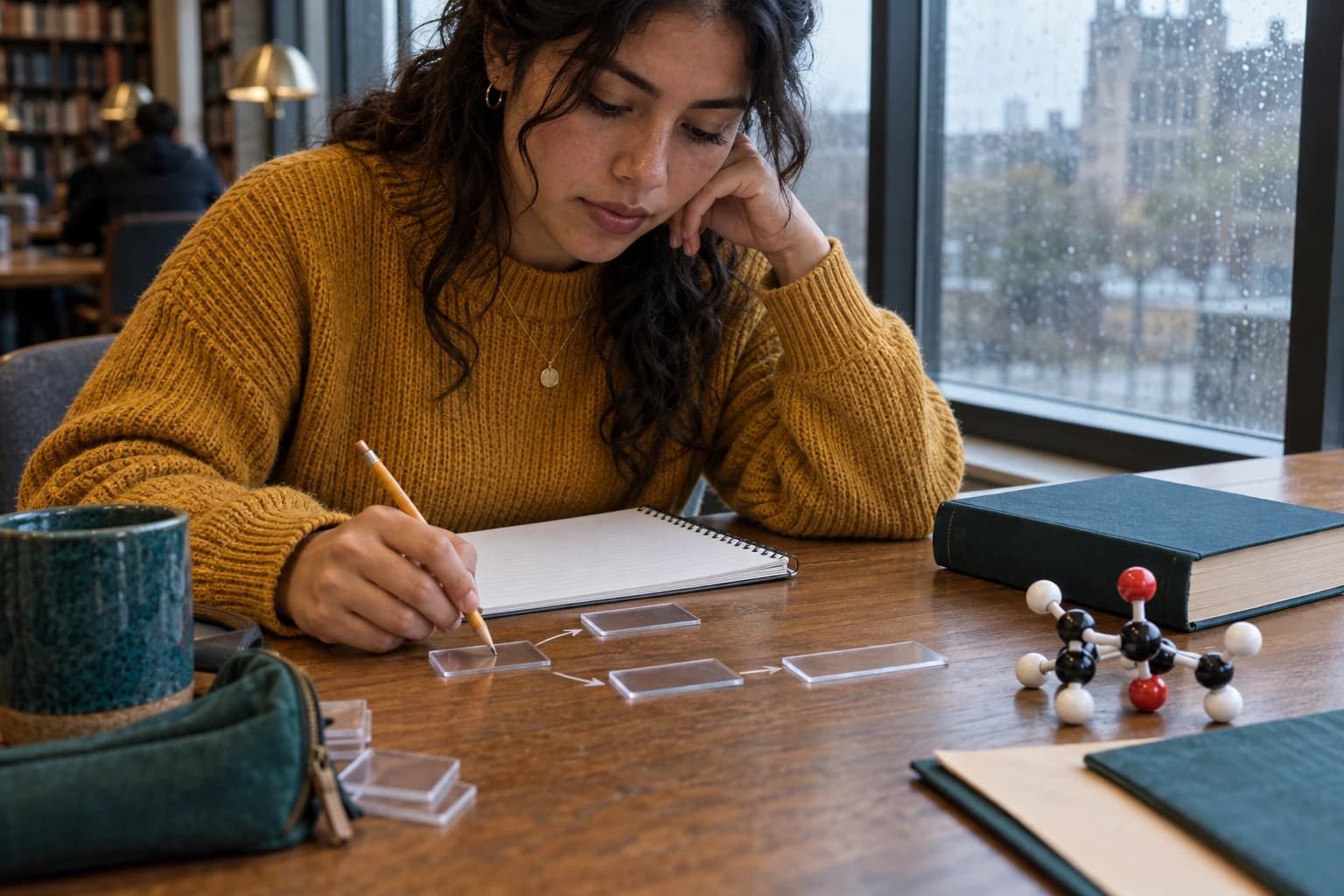
A balanced chemical equation adds a new conversion factor. In 2H₂ + O₂ → 2H₂O, the coefficients show a mole ratio of two moles hydrogen to one mole oxygen to two moles water. If 1.50 moles of oxygen react with enough hydrogen, multiply by 2 mol H₂O ÷ 1 mol O₂. The result is 3.00 moles of water. The ratio comes from coefficients, never from subscripts.
Balance the equation before using any ratio. An unbalanced equation does not conserve atoms and cannot supply valid stoichiometric relationships. Write the given substance under one coefficient and the wanted substance above the other so the starting mole unit cancels. If the task begins in grams, convert grams to moles first. Use the equation ratio second, then convert the resulting moles into the requested final unit.
8. Keep dimensional analysis readable across several steps
A multi-step problem is easier to audit as one connected chain. For grams of reactant to grams of product, the route is grams reactant → moles reactant → moles product → grams product. Each fraction should cancel the unit immediately before it. Write substance names or formulas beside every mole unit because moles of reactant and moles of product are different quantities even though both use mol.
Do not round after every fraction. Keep several calculator digits through the chain and round the final result according to the course rules. At the same time, avoid copying every displayed digit as if it were measured certainty. Significant figures communicate the precision of the given data. If your class has not introduced significant figures, follow the teacher's stated rounding rule rather than inventing one.
- Write one continuous unit-cancellation chain
- Label moles with the correct substance
- Keep guard digits until the final result
- Apply the class rounding rule once at the end
9. Diagnose the most common mole calculation mistakes
The most frequent errors are not complicated chemistry. They are wrong atom counts in molar mass, multiplying when the units require division, using subscripts as equation ratios, omitting the balanced equation, or confusing molecules with atoms. A calculator-entry error with scientific notation can shift a result by many powers of ten. Find the first line where the units or substance label stop matching the intended route.
Check the result three ways. First, inspect cancellation: does only the wanted unit remain? Second, estimate size: should the answer be above or below one mole? Third, reverse the conversion with the unrounded value. A grams-to-moles answer multiplied by the same molar mass should return the starting mass. If it does not, repair the earliest setup rather than adjusting the final number until it looks plausible.

Use estimation and data checks in other quantitative homework
10. Practise the decision, not one memorized number
Build a short mixed set rather than repeating one identical formula. Include one molar-mass question, one grams-to-moles conversion, one moles-to-grams conversion, one particle question, and one balanced-equation ratio. Before calculating, name the route and predict the direction of the result. Afterward, explain why each conversion factor is oriented the way it is. That explanation is stronger evidence of understanding than a row of calculator answers.
If you use Lirno, capture the complete task and verify that formulas, subscripts, units, and exponents were read correctly. Ask for a hint about the next conversion or a check of your setup, then make the next attempt yourself. An AI tutor can misread a formula or reason incorrectly, so confirm results with your course material and teacher-approved sources. Lirno cannot guarantee correctness, grades, mastery, or permission to use AI on an assignment; your school's rules still apply.
A useful final test: solve a new conversion without notes, keep every unit visible, and explain the route aloud.
Ask Lirno Tutor for a hint or a check of your chemistry setup