
English homework
AI English homework helper: check grammar, keep your voice
Use AI feedback to find grammar problems, understand the rule, revise your own English, and build practice from the mistakes you actually make.

You have written an English paragraph, but one sentence still sounds wrong. The deadline is close, the teacher expects your own work, and a correction without a reason will not help on the next assignment. An AI English homework helper is most useful here as a reviewer: it can point to a likely problem, explain the grammar, and wait while you decide how to revise.
This guide gives you a complete workflow for short answers, paragraphs, worksheets, and longer drafts. You will preserve the task, make a first attempt, request focused feedback, test each suggestion, and turn recurring errors into practice. AI can misread a photo or give incorrect language advice, so your course materials, teacher's instructions, and intended meaning remain the final reference.
1. Start with the exact English homework problem
Before asking for help, identify what the assignment actually measures. A grammar transformation exercise may require one tense, while a paragraph may be graded for meaning, organization, evidence, vocabulary, and accuracy. Copy the full prompt, including word limit, required form, source restrictions, and rubric. A tool cannot respect a condition it never sees.
Separate the prompt from your response. If you photograph the page, include the heading and instructions rather than one isolated sentence. Check that names, negatives, punctuation, blanks, and handwritten corrections were captured correctly. A missing not or question mark can reverse the task and produce confident but irrelevant feedback.
- What must I produce?
- Which grammar or skill is being assessed?
- What sources or tools are allowed?
- What must remain in my own words?
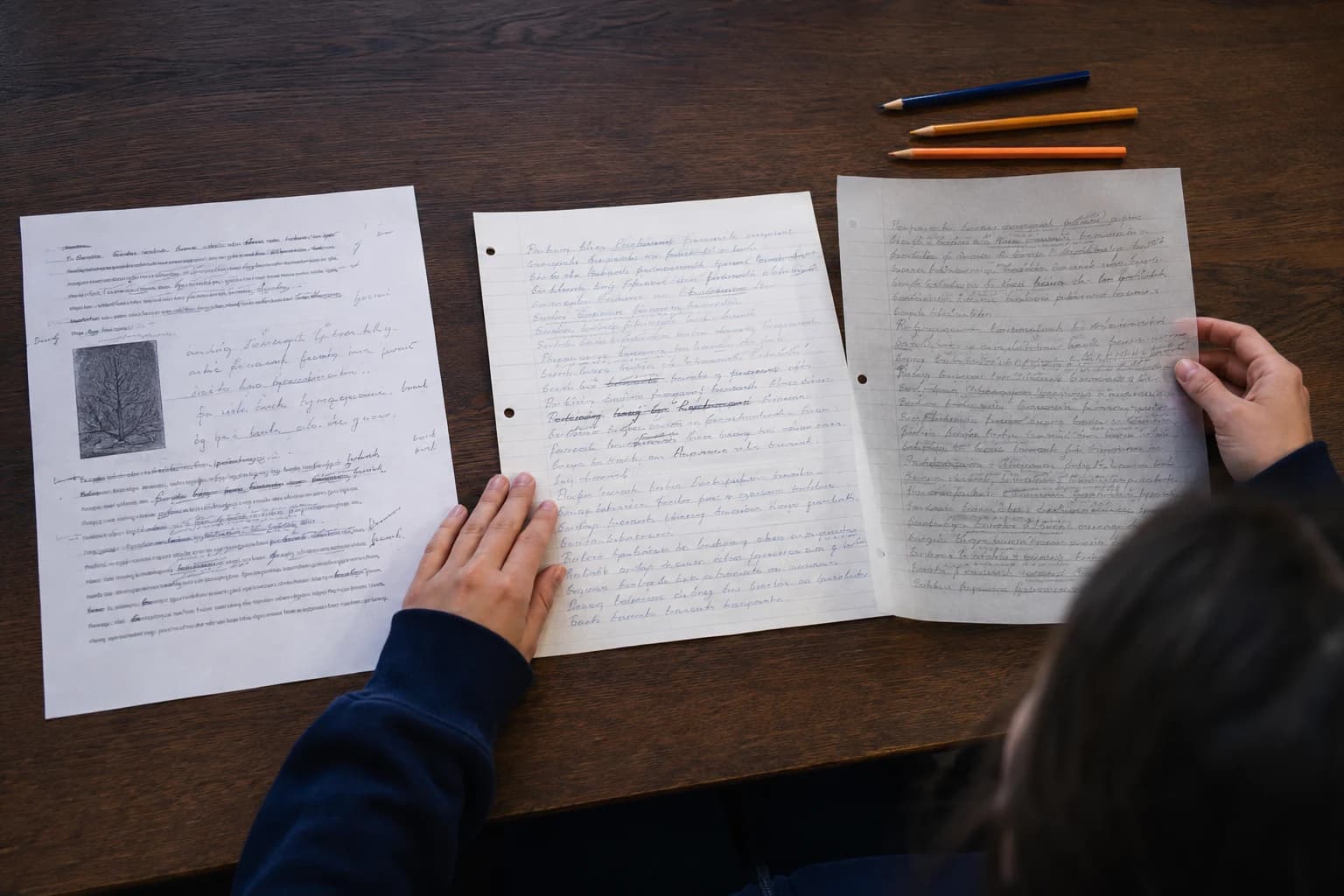
2. Make a first attempt before opening the AI tutor
Write the sentence you can produce now, even if it feels imperfect. A first attempt reveals the choice you were trying to make: past simple or present perfect, a or the, direct or indirect word order. If AI writes first, you lose that evidence and cannot tell whether the final sentence reflects your ability or the model's style.
Mark uncertainty without stopping the draft. Circle a verb, underline a preposition, or add a question mark in the margin. Finish the idea, then review the marked places. This keeps one difficult phrase from blocking the whole assignment and gives the tutor a precise question instead of a vague request to ‘make it better.’
Useful request: ‘I wrote this sentence myself. Point to one likely grammar problem and name the rule, but do not rewrite the paragraph.’
3. Choose the smallest kind of help that moves you forward
Different moments need different support. Choose a hint when you suspect the error but want to find it yourself. Choose an explanation when you do not understand the underlying rule. Choose Check after revising to see whether the sentence now matches your meaning. A complete rewrite should not be the default, because it removes the decision you need to learn.
In Lirno, verify the captured task and your draft before selecting Hint, Explain, or Check. Ask about one issue at a time: tense, article, word order, agreement, punctuation, or clarity. Narrow feedback is easier to judge and less likely to flatten your voice than a broad instruction to improve everything.
- Hint: show where to look
- Explain: teach the relevant rule
- Check: review your own revision
- Quick: clarify a small factual doubt
4. Diagnose the error before accepting a correction
A correction is useful only when you can name what changed and why. Compare your version with the suggestion word by word. Did the verb tense change because the time is finished? Was an article added because the noun is singular and countable? Did the word order change because English questions use an auxiliary? Write the rule in plain language.
Then test whether the proposed sentence still says what you meant. Grammatically possible alternatives can carry different emphasis, certainty, formality, or timing. If feedback changes your claim, restores information you intentionally omitted, or introduces vocabulary you would not normally use, reject or simplify it.

5. Check tense by building a time line
Verb tense errors often begin as meaning errors. Draw a small time line and place the event: finished in the past, connected to now, happening around now, or expected later. Then check whether the verb form expresses that relationship. Signal words can help, but they are clues rather than rules that automatically choose a tense.
For example, past simple usually presents a completed past event, while present perfect connects a past event or experience with the present and does not normally name a finished past time. Ask the tutor to contrast two short sentences and explain the difference. Then create your own pair using the same time relationship.
- Locate the event in time
- Identify whether the period is finished
- Choose the form that matches the meaning
- Write a new example without copying the model
6. Review articles, agreement, and word order separately
Do not review every grammar category at once. On the first pass, check whether singular countable nouns need a determiner such as a, an, the, this, or my. On the second pass, check subject–verb agreement and pronoun reference. On the third, inspect statement and question word order. Separate passes reduce the chance of overlooking a simple pattern.
When AI flags an article, ask why the listener can or cannot identify the noun. When it changes agreement, locate the true subject rather than the nearest noun. For word order, label the subject, auxiliary, main verb, object, and adverb. These questions turn a red correction into a structure you can reuse.
One sentence can contain several possible edits. Change one category at a time so you know which edit solved which problem.
7. Keep your voice while improving clarity
Clear writing does not require every sentence to sound like a textbook. Preserve your examples, degree of certainty, and natural vocabulary. Replace a sentence only when you understand the replacement and could produce a similar structure later. If a suggested phrase feels too advanced, ask for a simpler explanation, not a more impressive rewrite.
Read the revision aloud. Your ear can reveal a missing word, repeated phrase, or sentence that is too long to process comfortably. A read-aloud is not proof of grammatical accuracy, especially for a learner, but it adds a useful clarity check. Compare it with the assignment's expected register: a message, story, lab reflection, and formal essay do not use identical language.

8. Verify uncertain feedback with a trusted reference
AI language advice can be incomplete or wrong. It may prefer one valid variety of English, misread the sentence's context, or invent a rule after proposing a stylistic change. Treat absolute claims such as ‘always incorrect’ as a signal to verify. Check your course book, teacher examples, a reputable dictionary, or a trusted grammar resource.
The British Council's grammar materials organize explanations and practice by learner level, which can help you test a rule with examples. If sources disagree, keep the version required by your course and ask your teacher. Do not hide uncertainty behind a polished sentence; note the question while you still remember why it matters.
9. Revise in passes instead of chasing a perfect score
Use four short passes. First confirm that every sentence answers the prompt. Second check paragraph order and transitions. Third review the grammar categories that commonly trouble you. Fourth proofread spelling, punctuation, and formatting. Grammar is important, but a flawless sentence that does not answer the question still fails the assignment.
Stop when the response is accurate enough for your current level, expresses your meaning, and meets the instructions. Endless optimization can replace your style with generic wording and consume time needed for other work. Keep a small change log: original phrase, revised phrase, reason. That record makes later teacher feedback more useful.
- Meaning and task
- Organization and evidence
- Target grammar patterns
- Spelling, punctuation, and format
10. Turn repeated mistakes into targeted practice
After submitting, collect patterns rather than every typo. If three corrections involve past tense, that is one practice target. Make a flashcard that asks you to choose between two tenses and explain the time relationship. For articles, create contrasting noun contexts. For word order, rearrange a short set of sentence parts.
Use Lirno to turn the idea into a small quiz, but answer before revealing feedback. Mix recognition with production: identify an error, repair it, and write a fresh example. Schedule another short review a few days later. Practice is valuable when it makes the next independent draft easier, not when it merely stores the corrected homework.

11. Use a complete Lirno workflow without handing over the work
Capture the complete assignment and your attempt, then verify that the scan preserved every instruction and sentence. Choose the least intrusive help: Hint for direction, Explain for a rule, or Check for your revision. Make the next edit yourself and explain it aloud or in a margin note before asking for another check.
Once the response is finished, convert only the difficult concept into flashcards, a short quiz, or a study-plan task. Keep the submitted wording yours. Some schools restrict AI, and permission can differ by assignment, so follow the teacher's rules. Lirno cannot guarantee correctness, grades, mastery, or permission to use AI.
A strong session ends with a sentence you can explain and a practice task you can answer later—not a paragraph you could not reproduce.
12. Use this five-minute check before submitting
Reread the prompt and point to the sentence that fulfills each requirement. Check that every paragraph has one clear purpose and that examples support the claim. Review your personal error pattern, then read the final version aloud once. Confirm names, quotations, citations, word count, and file format where relevant.
Finally, choose one revised sentence and state why it is better. If you cannot explain the change, verify it again or return to wording you understand. The goal of an AI English homework helper is not to make your writing look machine-perfect. It is to help you notice, decide, revise, and carry one useful rule into the next assignment.
- I answered the exact prompt
- I can explain my main revisions
- The wording still expresses my meaning
- I checked uncertain advice and followed school rules